
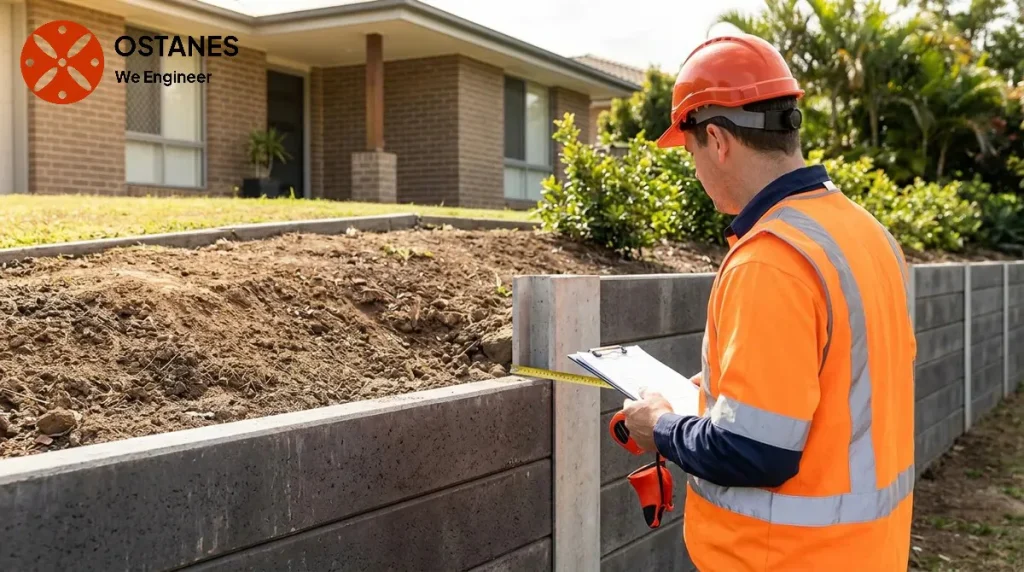
A retaining wall’s height alone does not determine whether approval is needed in Queensland. Check the actual council and building-certification conditions, including nearby loads, structures and any pool-barrier role.
Why retaining-wall approval is not determined by one rule
Retaining wall approval in Queensland involves different levels of regulation. It can fall under general planning scheme requirements, require a building approval, or necessitate professional engineering review. The distinction often lies in factors such as the wall’s height, whether it supports additional loads (surcharge loads), its proximity to boundaries or other structures, and the unique conditions of the site itself. Each local government area may also have specific requirements that add to or modify state-level guidance. Therefore, a comprehensive assessment considers all these aspects.
How Queensland retaining-wall approval is assessed
Check the complete exemption conditions and site constraints with the council and building certifier. Nearby loads, other structures and a pool-barrier role can change the position even where a wall is relatively low.
The proximity of a retaining wall to property boundaries or existing structures is another critical factor. Walls built close to or on a boundary line may have different requirements due to potential impacts on neighbouring properties or shared assets. Site conditions, including soil type, groundwater, and overall slope, can also influence the need for engineering assessment and subsequent approval. Many local councils in Queensland have specific planning scheme overlays or bylaws that address retaining walls, particularly in areas prone to landslip or with unique environmental characteristics. For accurate guidance, a private certifier or the relevant local council can provide clarity on your specific circumstances.
Check Queensland rules before relying on online advice
When researching retaining wall regulations, it is crucial to ensure that the information you find applies specifically to Queensland. Rules regarding retaining wall approval, height thresholds, and boundary clearances can vary significantly between Australian states. Relying on advice or general landscaping guidelines from other jurisdictions, such as New South Wales or Victoria, may lead to incorrect assumptions for a Queensland property.
To ensure accuracy, property owners should consult official Queensland government sources, which outline state-level building and planning requirements, including guidance that may affect retaining walls. Your local council’s website is also an essential resource, as individual councils often have specific planning schemes and local laws that supplement state regulations. These local provisions can address specific environmental conditions, urban design considerations, or other factors unique to the area. Verifying information against these official Queensland-specific sources is key to understanding your obligations.
What information to gather before contacting council or a certifier
Before contacting your local council or a private certifier regarding a retaining wall, prepare the following information about the property and wall:
- Property details: Your exact street address and lot and plan numbers.
- Wall location: Where on the property the retaining wall is or will be situated.
- Wall dimensions: The approximate height and length of the wall.
- Surrounding structures: Details of any buildings, pools, driveways, or other significant structures on your property or neighbouring properties that are close to the wall.
- Boundary relationship: How close the wall is to property boundaries and whether it forms part of a boundary.
- Site conditions: General observations about the ground slope, soil type (if known), and any apparent drainage issues in the area.
- Additional loads: Any planned or existing loads near the wall, such as a parked vehicle area, landscaping features, or a tiered garden.
- Existing documentation: Any previous plans, approvals, or engineering reports related to the property or retaining structures.
Having this information ready allows the council or certifier to provide more accurate initial guidance.
When professional review may be needed
In situations where a retaining wall’s approval status is unclear, or the design involves complexities such as significant height, substantial surcharge loads, challenging site conditions, or close proximity to boundaries, professional review may be justified. A Registered Professional Engineer of Queensland (RPEQ) can assess the specific engineering requirements for the wall and its interaction with the surrounding environment.
When does a retaining wall need approval in Queensland?
A retaining wall may need approval in Queensland depending on its height, the presence of surcharge loads (additional weight on the retained ground), its proximity to boundaries or other structures, and specific local council regulations. Property owners should consult the relevant Queensland government guidelines and their local council for precise requirements.
Does a retaining wall near a boundary need council approval?
Proximity to a boundary can be a significant factor in whether a retaining wall requires council approval. Specific Queensland and local council provisions often address boundary clearances and shared structures. It is advisable to check with your local council or a private certifier for guidance on your particular situation.
Can a surcharge load change the approval position?
Yes, a surcharge load can change the approval requirements for a retaining wall. Surcharge loads, such as a driveway, building, or swimming pool placed on or near the ground retained by the wall, can increase the pressure on the structure and may trigger the need for engineering design and council approval.
Should I contact council or a private certifier?
Both your local council and private certifiers can provide guidance on retaining wall approval. Councils manage planning scheme requirements and local laws, while private certifiers are authorised to assess and approve building work against the Building Code of Australia and other applicable standards. For an initial understanding, you might start with your local council, or engage a private certifier if building approval is clearly required.
How can I check whether an engineer is an RPEQ?
To verify if an engineer is a Registered Professional Engineer of Queensland (RPEQ), you can use the official register provided by the Board of Professional Engineers of Queensland (BPEQ). This register, accessible via bpeq.qld.gov.au, allows you to search for registered engineers and confirm their current registration status.
Check the Brisbane exemption as a set of conditions
Brisbane City Council’s retaining-wall guidance lists exemption conditions that must all be met: no surcharge loading over the zone of influence, combined wall and retained cut/fill height no more than one metre, at least 1.5 metres from a building or another retaining wall, and no pool-fence role. Height alone is therefore insufficient. Planning overlays and other site constraints may still matter. Ask the certifier and council about the actual proposal; engineering design and development approval are separate parts of the pathway. Council conditions
Related property guidance
For background on the related issue, read concrete sleeper retaining-wall design and condition. Use it alongside the project-specific evidence and service scope described in this guide.
Discuss your project with Ostanes Engineering
For help with the structural questions in this guide, discuss retaining-wall engineering with Ostanes Engineering. structural engineering design may also be relevant where the assessment or proposal identifies that need. Agree on the scope, evidence and deliverables before commissioning additional work.
For a project-specific cost estimate, complete the contact form with your property location, the concern or proposed work, safe photographs and any available drawings, soil report or earlier reports. The team will respond as soon as possible.
Official references and further reading
For the relevant regulatory or maintenance context, consult Brisbane retaining-wall guidance and Queensland approvals and inspections.
