
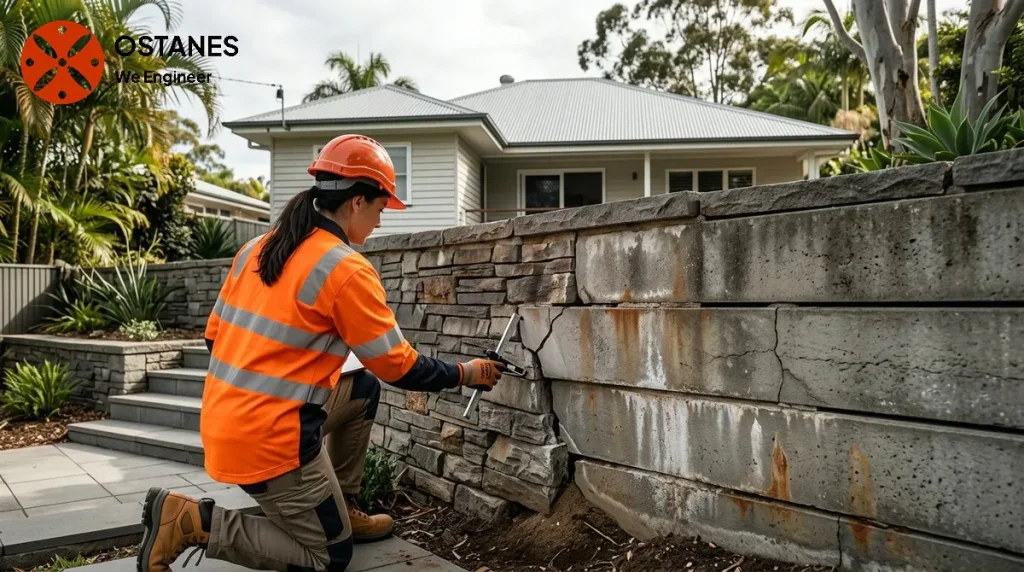
Leaning, bulging, displaced joints and loss of retained soil can indicate retaining-wall distress. Assess the wall, drainage, supports and nearby loads together, and keep clear of an apparently unstable structure.
What retaining wall failure signs may indicate
Observing a retaining wall for changes can help identify potential issues. These observations often fall into categories that may indicate specific types of movement or drainage problems, but visual signs alone do not establish a definitive cause for a specific wall.
Wall Rotation or Leaning:
A retaining wall leaning outwards from its original vertical position, or appearing to rotate, can be a visual cue of movement. This might be uniform along the wall’s length or more pronounced in certain sections. A retaining wall leaning may indicate inadequate design for the soil pressures, issues with the foundation, or changes in the surrounding ground.
Bulging:
When sections of a retaining wall push outwards in a convex shape, this is known as bulging. This is distinct from a uniform lean and often points to localised pressure build-up behind the wall, possibly due to soil expansion or increased hydrostatic pressure if drainage is compromised.
Cracking:
Cracks in a retaining wall can vary in size, pattern, and location. Horizontal cracks, vertical cracks, or stair-step cracks in masonry walls can be signs of stress. The nature and progression of these cracks can offer clues about underlying forces, such as settlement, differential movement, or expansive soil.
Blocked or Ineffective Weep-Hole Drainage:
Many retaining walls incorporate weep holes to allow water to escape from behind the wall, reducing hydrostatic pressure. If these weep holes are blocked, or if water is visibly pooling at the base of the wall even with functioning weep holes, it can be a sign that the drainage system is ineffective. This build-up of water pressure can significantly contribute to wall instability.
Subsoil Movement:
Observations beyond the wall itself can also be critical. Cracks in the ground surface behind or near the wall, sinking areas, or changes in the appearance of garden beds and paving adjacent to the wall can be indicators of subsoil movement. These changes may indicate that the ground supporting the wall is shifting or that the soil is being eroded. These retaining wall movement signs, whether individually or in combination, suggest that a deeper assessment is prudent.
Urgency: when observations need prompt attention
Not all observations signal immediate danger, but certain failing retaining wall symptoms warrant prompt professional attention. Situations indicating acute risk or active progression should be prioritised.
You should seek immediate professional inspection if you observe:
- Rapidly Worsening Conditions: Any sign, such as new cracks appearing quickly, existing cracks widening noticeably, or an increased lean or bulge developing over days or weeks rather than months or years.
- Displaced Components: If individual blocks, stones, or sections of the wall are clearly dislodged, separated, or falling out.
- Exposed Ground or Foundation: If the base of the wall is undercut, or if significant amounts of soil are washing out from beneath or behind the wall, exposing the foundation.
- Acute Safety Hazards: Visible signs of imminent collapse, such as significant portions of the wall bowing outward dramatically, or a wall that has already partially failed.
- Water Surging from Behind the Wall: If significant volumes of water are suddenly flowing from behind the wall, especially during or after rainfall, suggesting a major drainage failure.
These scenarios suggest active movement or compromised integrity that could lead to further damage or safety concerns. Less urgent observations may allow for monitoring, but active progression or signs of immediate instability necessitate prompt expert evaluation.
How to document retaining wall changes over time
Careful documentation of changes can provide valuable data for an engineering assessment, helping to understand the progression of any issues. This process focuses on safe observation and recording without attempting repair or intervention. DV-01 Connect visible retaining wall failure signs with a disciplined record of change over time while keeping the guide focused on observation rather than diagnosis or repair.
When you observe changes, record the following details:
- Location: Pinpoint the exact area of concern on the wall. You can use landmarks, measurements from a fixed point, or simple sketches to indicate where the observation was made.
- Pattern: Describe the shape or nature of the observation. For cracks, note if they are horizontal, vertical, diagonal, or stair-stepped. For bulges, describe their extent and highest point.
- Direction: Note the direction of any movement. Is the wall leaning outwards, or is a section displacing horizontally? For cracks, note if one side appears higher or offset from the other.
- Progression: Document if the observation is new or if it has changed over time. Take dated photographs from the same vantage point to compare against future observations. You can mark the ends of cracks with a pencil and date them to monitor their growth.
- Visible Deformation: Beyond leaning or bulging, note any other visible deformation, such as twisting or warping of wall materials.
- Drainage Condition: Observe water flow around the wall. Are weep holes clear? Is water pooling at the base? Are there signs of erosion or washouts behind or in front of the wall? Note these conditions, especially after rainfall.
- Surrounding Ground Changes: Look for associated changes in the adjacent soil, such as new cracks in the ground, depressions, or displaced paving stones.
These records, coupled with dated photographs, create a valuable historical account. This information supports an engineering assessment by providing context regarding the nature and timeline of observable changes, without establishing the cause or safety of a specific wall. Such detailed records are distinct from foundation maintenance guidance, which generally focuses on broader site conditions affecting footings.
Queensland context and source boundaries
Retaining-wall assessment considers the actual wall system, retained ground, nearby loads, drainage and support conditions. Residential slab and footing guidance is not a retaining-wall design specification. The engineer should identify the appropriate assessment and design basis for the actual structure.
Is a leaning retaining wall always failing?
A leaning retaining wall indicates movement, but not every lean means imminent failure. The cause and severity of the lean require professional assessment, as factors like soil type, drainage, and wall construction all play a role. It is not possible to diagnose the condition of a specific wall from its appearance alone.
What are common retaining wall movement signs?
Common signs of retaining wall movement include the wall leaning or rotating outwards, sections bulging, the development or widening of cracks, blocked or ineffective weep holes, and signs of subsoil movement like ground cracks or sinking areas nearby.
Why do blocked or ineffective weep holes matter?
Weep holes are crucial for releasing hydrostatic pressure from water trapped behind a retaining wall. If they are blocked or not functioning effectively, water can build up, increasing pressure on the wall and potentially contributing to movement or instability.
How should I record changes in a retaining wall?
To record changes, note the location, pattern (e.g., crack shape), direction of movement, and any visible deformation. Take dated photographs from consistent angles. Also, observe and record the drainage conditions around the wall and any changes in the surrounding ground.
When should I seek professional inspection?
You should seek professional inspection promptly if you observe rapidly worsening conditions, displaced wall components, exposed ground or foundation at the wall’s base, acute safety hazards, or significant water surging from behind the wall.
Record retaining-wall distress without entering the failure zone
Photograph leaning, bulging, displaced joints, water discharge and the ground above and below from a safe location. Keep people clear of a visibly unstable wall and avoid loading its crest. Record nearby buildings, driveways, pools and other walls, because their loads may affect the investigation. A condition assessment should consider the wall, support and drainage together. Repair or replacement design is a separate step once the cause and site constraints are sufficiently understood.
Related property guidance
For background on the related issue, read concrete sleeper retaining-wall design and condition. Use it alongside the project-specific evidence and service scope described in this guide.
Discuss your project with Ostanes Engineering
For an existing wall showing cracking or movement, begin with structural inspection. If repair or replacement requires a new structural solution, retaining-wall engineering can be scoped separately once the condition and site constraints are understood.
Complete the contact form with your property location, the concern or proposed work, safe photographs and any available drawings, soil report or earlier reports. Contact us through the form for a project-specific cost estimate. The team will respond as soon as possible.
Official references and further reading
For the relevant regulatory or maintenance context, consult Brisbane retaining-wall guidance and QBCC home maintenance. These resources complement the project-specific advice described above.
