
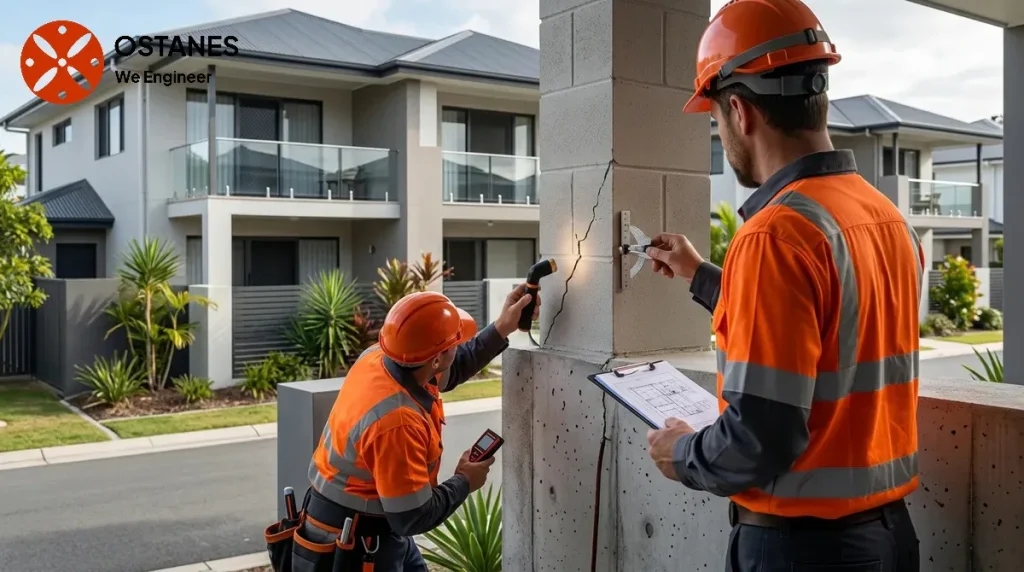
For body-corporate defects, establish the physical condition and relevant records before deciding on repair or responsibility. Structural findings and legal maintenance obligations are related but different questions.
Why building defect responsibility is difficult to determine
A visible defect, such as cracking or water ingress, often sparks questions about who is responsible for assessment and repair. However, attributing responsibility is complex because it can involve aspects like the building’s original design and construction, subsequent modifications, maintenance history, and the specific legal framework governing body corporate properties. Technical observations can identify the nature and extent of a defect, but they do not automatically assign legal responsibility. That determination typically requires combining engineering insights with legal interpretation, considering all available records and the specifics of the situation. This technical documentation helps clarify the physical problem without prejudging who might ultimately be responsible for addressing it.
Common property, lot property and the limits of a technical assessment
Understanding the physical distinction between common property and lot property is fundamental when addressing building defects. In Queensland, the Body Corporate and Community Management Act 1997 (Qld) defines these classifications, which often dictate how maintenance and repairs are managed. Common property generally includes structural elements, the exterior of buildings, and shared facilities, while lot property refers to the internal spaces within an individual apartment.
An engineer can assess the physical condition of various building elements, irrespective of whether they fall under common property building defects or lot property. This assessment identifies observed conditions, patterns of damage, and potential causes from an engineering perspective. However, an engineer’s role is to provide a technical evaluation of the physical state of the building. They do not interpret body corporate by-laws, subsidiary documents, or make legal declarations about ownership, maintenance obligations, or legal liability for specific defects. Those aspects require consultation with legal professionals who specialise in body corporate law and can interpret the relevant governing documents in light of the physical evidence.
Documenting the physical evidence before discussing responsibility
Record the physical evidence before discussing responsibility for an apartment defect. Start with its location within the building, room or external area. This record supports later professional assessments and discussions.
Photographs are essential. Take multiple images showing the defect’s overall context and detailed close-ups. Include a scale, such as a ruler or coin, in close-up shots to indicate size. Record the date and time each photograph was taken.
Observe and record the pattern of the defect—is it a single crack, a network of cracks, or a widespread stain? Note its extent: how long, wide, or deep is it? Pay attention to apparent movement: are there signs the defect is widening, shifting, or has been patched previously? Describe the materials affected (e.g., concrete, plaster, tiling).
Document surrounding conditions, such as nearby plumbing, drainage, garden beds, or changes in ground levels, which may be relevant context. Collect any available records, including prior reports, maintenance logs, building plans, or correspondence related to the defect or adjacent areas. The more factual and objective the documentation, the more useful it will be for any subsequent engineering or legal review. This process focuses on observable facts, helping to distinguish between physical conditions and conclusions about their cause or responsibility.
What an engineering report can and cannot establish
An engineering report serves as a technical document that systematically records observed conditions, evaluates potential contributing factors, and identifies areas that may require further investigation. For instance, in Queensland, the Building Act 1975 (Qld) sets out aspects of building standards and compliance, and an engineering report can assess whether observed conditions align with accepted engineering principles or standards at the time of construction.
The report provides an expert opinion on the physical state of the building and the likely engineering reasons for its condition. It can describe cracking patterns, assess material deterioration, and comment on structural integrity. However, it is important to understand the limits of this technical assessment. An engineering report typically avoids making definitive statements about legal causation or assigning legal liability. For example, while it may identify conditions consistent with settlement, it will not declare who is legally responsible for that settlement. Similarly, it will not guarantee compliance outcomes, certification, or approval of any proposed rectification works.
Questions of legal liability, dispute strategy, and whether an engineering report will be admissible or given specific weight in legal proceedings are matters for legal professionals. Lawyers advise on the evidentiary use of such reports, how they fit into a legal argument, and what implications they might have under relevant legislation or contractual agreements.
When to seek an engineering assessment
An engineering assessment becomes necessary when observations and photographic evidence alone are insufficient to understand the nature or potential implications of a building defect. This is particularly true when defects appear to affect shared building elements, where there’s uncertainty about the cause, or when an impartial technical record is required before making significant legal or governance decisions within a body corporate.
Consider seeking professional engineering advice if:
- The defect is worsening, appears suddenly, or involves significant cracking or displacement. Such acute-risk scenarios warrant immediate professional inspection.
- Records and photographs do not fully explain the condition, or there is conflicting information about the building’s history or modifications.
- The defect is in an area that could impact multiple lots or common property, making its classification and cause critical for all stakeholders.
- Technical guidance is needed to determine appropriate next steps, even if liability remains to be established.
Questions to take to the right professional
When addressing building defects in a body corporate, it is helpful to frame questions based on who can best answer them. Here’s a way to separate engineering questions from legal and body corporate queries:
- For an Engineer:
- “What are the observed conditions of the defect?”
- “What are the likely physical causes or contributing factors?”
- “Does the defect show signs of ongoing movement or deterioration?”
- “Are there implications for the structural integrity of the building?”
- “What further investigations or monitoring do you recommend to fully understand the problem?”
- For the Body Corporate Manager/Committee:
- “Are there any past maintenance records, reports, or plans related to this area of the building?”
- “What do our by-laws and community management statement say about maintenance responsibility for this specific component?”
- “Have similar issues been reported or addressed previously within the scheme?”
- For a Legal Professional:
- “Based on the engineering findings and our governing documents, who is legally responsible for this defect?”
- “What are the legal implications of this defect for the body corporate or individual lot owners?”
- “What steps should we take to resolve this dispute, if any, and what are our legal options?”
- “What are the requirements for an engineering report to be considered as evidence in a legal proceeding?”
Does a defect in an apartment automatically become a body corporate responsibility?
No, not automatically. Whether a defect in an apartment falls under body corporate responsibility depends on various factors, including the physical location of the defect (common property versus lot property), the specific wording of the body corporate’s governing documents, the cause of the defect, and legal interpretation.
What evidence should an owner or committee keep about a building defect?
Owners or committees should keep factual evidence such as dated and contextual photographs of the defect, precise location information, records of when the defect was first noticed and any changes over time, and copies of any relevant building plans, maintenance logs, or past communications related to the area.
Can an engineer decide who is legally responsible for a defect?
An engineer can assess the physical conditions of a defect, identify its likely technical causes, and evaluate its implications for the building. However, an engineer cannot make a legal determination of responsibility. That is a matter for legal professionals who interpret the relevant laws, contracts, and body corporate documents.
Will an engineering report be accepted in a court dispute?
While an engineering report provides critical technical evidence, its admissibility and the weight it carries in a court dispute cannot be guaranteed by the engineer. Questions about the report’s use as evidence in legal proceedings should be directed to an appropriate legal professional.
Document defects before deciding responsibility
Record the location, date, progression and effect of each issue, and obtain permission before accessing common areas. Keep previous reports and correspondence together. The engineering task is to assess condition, possible cause and remedial options within the agreed scope. Responsibility for a wall, slab, balcony or service depends on the scheme and legal arrangements, rather than a universal rule that every structural item belongs to the body corporate. Separate the technical report from legal advice and any formal dispute process.
The Queensland maintenance responsibilities guidance emphasises identifying the plan of subdivision and applicable regulation module. Those records help establish boundaries and maintenance arrangements; an engineer’s technical finding should not be treated as a legal allocation of responsibility.
Discuss your project with Ostanes Engineering
For help with the structural questions in this guide, discuss pre-purchase structural inspection with Ostanes Engineering. structural inspection may also be relevant where the assessment or proposal identifies that need. Agree on the scope, evidence and deliverables before commissioning additional work.
For a project-specific cost estimate, complete the contact form with your property location, the concern or proposed work, safe photographs and any available drawings, soil report or earlier reports. The team will respond as soon as possible.
Official references and further reading
For the relevant regulatory or maintenance context, consult Queensland body corporate records and Queensland maintenance responsibilities.
