Finding a crack in a wall can be unsettling, but it does not automatically mean that your home has a serious structural problem. Fine cracks can develop as building materials dry, finishes shrink or different parts of a building respond to changes in temperature and moisture.
A crack becomes more concerning when it is new, widening, returning after repairs or accompanied by other signs of movement. Diagonal or stair-step cracking, wall bulging, uneven floors, sticking doors and windows, or separation between building elements can justify assessment by a structural engineer.
The appearance of a crack alone cannot reliably establish its cause or structural significance. Its location, direction, progression and relationship with the rest of the building all need to be considered.
When Should You Worry About Cracks in Walls?
Arrange professional advice when a wall crack:
- appeared suddenly or has noticeably widened
- continues to lengthen or spread
- reopens repeatedly after cosmetic repairs
- runs diagonally from a door or window opening
- follows a stair-step pattern through brickwork or mortar joints
- is horizontal and accompanied by wall bowing or bulging
- has visible displacement on either side
- extends through several connected building elements
- is accompanied by sticking or distorted doors and windows
- appears alongside sloping, uneven or bouncy floors
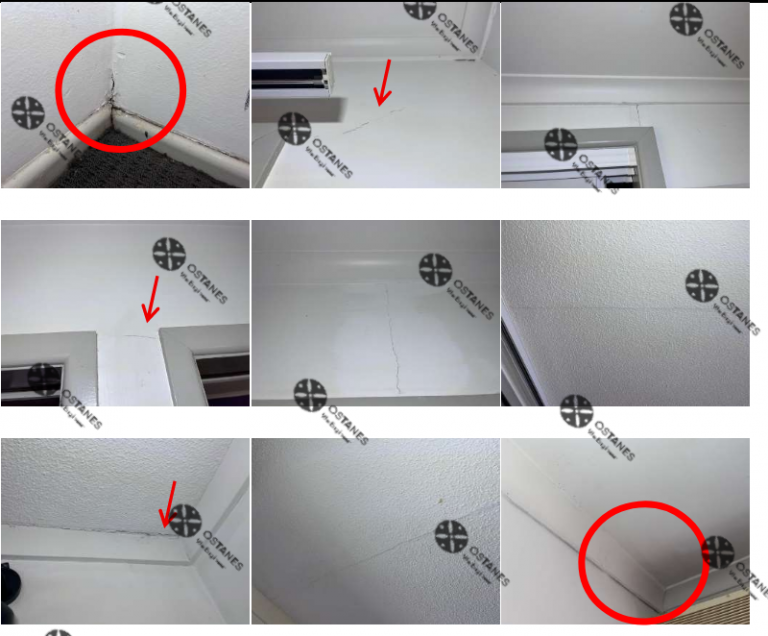
- is associated with gaps between walls, ceilings, cornices or floors
- developed after a storm, flood, fire, impact or nearby construction work
The presence of one warning sign does not prove that a structure is unsafe. It indicates that the crack should be assessed in the context of the complete building rather than treated as an isolated surface defect.
Why Do Cracks Appear in Walls?
Wall cracks can develop for many reasons. Some affect only the paint, plaster or plasterboard finish. Others may reflect movement within the foundations, framing, masonry or supporting structural system.
Material shrinkage
Concrete, render, plaster and jointing compounds can shrink as they dry. This may create fine cracks during or after construction, particularly at joints or where materials of different types meet.
Thermal and moisture movement
Building materials expand and contract as temperature and moisture levels change. Repeated movement may produce cracking at junctions, around openings or where movement has not been adequately accommodated.
Foundation and ground movement
A building may crack when one part of its foundation moves differently from another. This is known as differential movement.
The Queensland Building and Construction Commission notes that many Queensland homes are constructed on clay soils. Changes between dry and wet conditions can cause these soils to shrink or swell, contributing to ground and foundation movement.
Poor drainage, leaking pipes and changes to landscaping can also alter moisture conditions around footings. Further information is available in the QBCC guidance on protecting homes against subsidence.
Changes to the structural system
Removing walls, enlarging openings, modifying roof framing or completing additions without properly transferring loads can cause stress to appear elsewhere in a building. Cracking may develop around beams, columns, lintels or altered wall sections.
Deterioration or damage
Water entry, corrosion, timber deterioration, impact damage and prolonged environmental exposure can reduce the performance of structural elements. The visible crack may be only one symptom of a wider problem.
Movement between old and new construction
Extensions and renovations often connect new construction to an existing building. If the two sections have different foundations, materials or movement characteristics, cracking may appear along the interface.
What Do Structural Cracks Look Like?
There is no single crack shape that proves structural damage. However, certain patterns deserve closer attention.
| Crack pattern or observation | What it may be associated with | Appropriate response |
|---|---|---|
| Fine, isolated crack in paint or plaster | Drying, shrinkage or local finish movement | Photograph and monitor |
| Crack along a plasterboard joint | Joint or finishing movement | Monitor for reopening or extension |
| Diagonal crack from a door or window | Local stress, movement around an opening or support movement | Investigate if new, widening or accompanied by distortion |
| Stair-step crack through masonry joints | Differential foundation or wall movement | Arrange engineering assessment |
| Horizontal crack with wall bulging | Lateral pressure, inadequate restraint or deterioration | Seek prompt professional assessment |
| Crack with visible displacement | Movement between adjoining parts of the wall | Arrange engineering assessment |
| Crack accompanied by sloping floors or sticking doors | Possible wider building movement | Assess the building as a complete system |
| Sudden cracking after an impact, storm, flood or fire | Event-related damage | Restrict access if necessary and obtain urgent advice |
These patterns are indicators, not diagnoses. A diagonal crack can have several possible causes, while a fine crack may still require attention if it is rapidly changing or appears across an important structural element.
Are Hairline Cracks Always Harmless?
No. Many hairline cracks affect only finishes and remain stable, but “hairline” is a description of width rather than cause.
A fine crack may be less concerning when it:
- remains unchanged over a long period
- is limited to paint, plaster or a plasterboard joint
- has no visible displacement
- is not accompanied by movement elsewhere
- developed during normal drying of relatively new finishes
It deserves closer attention when it is growing, spreading, recurring or associated with distortion in adjacent parts of the building.
Important: Crack width should not be used as a universal stand-alone test of structural significance. Direction, location, progression, displacement and related building movement also need to be considered.
Why Crack Direction and Location Matter
The direction of a crack can help an engineer understand how a wall may be moving.
Vertical cracks
Vertical cracks may occur because of shrinkage, movement at a construction joint or differential movement. Their significance depends on where they occur, whether the sides have separated and whether the crack is changing.
Diagonal cracks
Diagonal cracks commonly appear near doors and windows because openings interrupt the continuity of a wall. They can be associated with localised stress, lintel movement or differential foundation movement.
Stair-step cracks
Stair-step cracks follow mortar joints in brick or block walls. They may indicate that one part of the wall or foundation has moved relative to another, particularly when the crack is widening or accompanied by distortion.
Horizontal cracks
Horizontal cracks may be associated with lateral pressure, corrosion, inadequate restraint or movement between different parts of a wall. A horizontal crack accompanied by bowing or bulging should receive prompt attention.
Cracks at wall and ceiling junctions
Separation at cornices or between walls and ceilings may result from finish movement, roof movement, truss behaviour or relative movement between structural elements. Related ceiling sagging or wall distortion makes assessment more important.
Warning Signs Beyond the Crack Itself
A structural engineer does not assess a wall crack in isolation. The behaviour of the surrounding building often provides more useful evidence.
Look for:
- doors or windows that have recently started sticking
- frames that appear out of square
- floors that slope, dip or feel unusually flexible
- gaps between walls, floors, ceilings or cabinetry
- separation around an extension or alteration
- cracked floor tiles or slabs
- movement in external paving near the building
- retaining wall movement close to the house
- damaged or disconnected gutters and downpipes
- water pooling beside the foundations
- leaking plumbing or air-conditioning discharge near footings
- recent excavation, tree removal or major landscaping
- similar cracking on the opposite side of the wall
Several related symptoms occurring together can be more significant than the width of one crack.
Queensland Conditions That Can Contribute to Wall Cracking
Queensland buildings can experience substantial changes in ground moisture between dry periods and prolonged rainfall.
The QBCC explains that clay soils can undergo volume changes as their moisture content changes. It recommends maintaining effective site drainage, directing water away from buildings and addressing leaks from gutters, downpipes, water systems and other sources near footings.
The CSIRO Foundation Maintenance and Footing Performance guidance also addresses the relationship between soil moisture, foundation movement and cracking. Consistent moisture conditions and appropriate drainage are important parts of protecting footing performance.
Other relevant conditions can include:
- reactive soils
- sloping or filled sites
- inadequate surface drainage
- leaking underground services
- erosion near foundations
- changes to mature trees
- extended dry weather followed by heavy rain
- nearby excavation or construction
- flood, storm or impact damage
These conditions do not establish the cause of a particular crack. They form part of the site history that may need to be investigated.
When Can You Monitor a Crack?
Monitoring may be reasonable when a crack appears limited to a finish, remains stable and is not accompanied by other signs of movement.
A simple record should include:
- A clear photograph of the entire crack.
- Close-up photographs with a consistent scale for reference.
- The date each photograph was taken.
- The crack’s location on a basic floor plan.
- Notes about recent rainfall, plumbing leaks, renovations or landscaping changes.
- Any changes in nearby doors, windows, floors or ceilings.
Take photographs from the same position and under similar lighting conditions. Do not rely on pencil marks alone, as they can be painted over or become difficult to interpret.
Monitoring should not delay professional assessment when a crack is changing rapidly or associated with visible instability.
When Is Prompt Assessment More Appropriate Than Monitoring?
Contact a structural engineer without waiting for an extended monitoring period when:
- the crack appeared suddenly
- the crack is visibly progressing
- the wall is bulging, leaning or separating
- masonry has become loose
- a door or window opening has distorted significantly
- the floor has developed a noticeable slope or level change
- cracking followed an impact, fire, flood or severe storm
- nearby excavation may have affected the property
- a retaining wall close to the building is moving
- a property transaction or renovation decision depends on understanding the issue
If part of a wall or ceiling appears unstable, keep people away from the affected area. Do not remove finishes, masonry or structural elements to investigate the problem yourself.
Should You Repair a Crack Before It Is Assessed?
Repairing the surface before understanding the cause can conceal useful evidence. It may also result in the crack reopening if the underlying movement is continuing.
Before patching:
- photograph and document the crack
- record when it first appeared
- note whether it has changed
- check for related symptoms
- preserve previous reports, plans and repair records
- address active water leaks through an appropriate licensed professional
A plasterer or painter can repair finishes, but they are not responsible for determining whether the supporting structure or foundations are moving. Where the cause or significance is uncertain, an engineering assessment should come before repeated cosmetic repair.
What Does a Structural Engineer Consider?
A structural engineer may consider:
- the crack’s direction, location and continuity
- whether there is visible displacement
- movement around doors and windows
- wall alignment and distortion
- floor levels and changes across the building
- the condition of slabs, footings and supporting elements where accessible
- connections between walls, floors, roofs and extensions
- drainage, moisture and relevant site conditions
- the history of construction, alterations and previous repairs
- whether monitoring or further investigation is required
Further work may include plumbing tests, level surveys, geotechnical input or remedial structural design, depending on the available evidence.
In Queensland, professional engineering services must be provided within the state’s RPEQ framework. The Board of Professional Engineers of Queensland maintains the registration system and public directory.
Structural Engineer or Building Inspector?
A general building inspection covers a broad range of accessible property conditions. It may identify cracking and recommend further specialist advice.
A structural engineer is appropriate when the question concerns:
- structural significance
- foundation or building movement
- load paths
- wall, beam, floor or roof performance
- the likely mechanism causing distress
- engineering recommendations or remedial design
Ostanes Engineering does not provide pest inspections or combined Building and Pest Reports. Where a third-party report identifies a possible structural concern, an engineer can assess that structural issue within an agreed scope.
Frequently Asked Questions
Are all cracks in walls structural?
No. Many cracks occur in paint, plaster, render or plasterboard finishes. A crack may be structural when it is associated with movement or distress in a load-bearing element, but this cannot be confirmed from appearance alone.
Can you tell if a crack is structural by its width?
Width is only one factor. Direction, location, displacement, progression and related symptoms can be equally important. A narrow but rapidly changing crack may require more attention than a wider crack that has remained stable for years.
Are stair-step cracks in brick walls serious?
Stair-step cracking can be associated with differential movement in masonry or foundations. It warrants assessment when it is new, widening, displaced or accompanied by sticking openings, uneven floors or other movement.
Should I worry about a crack above a door or window?
Cracks commonly develop around openings because stresses concentrate at their corners. Assessment is advisable if the crack is diagonal, progressing or accompanied by distortion of the frame.
Why does a wall crack keep returning after repair?
Recurring cracks can result from continuing movement, inadequate preparation, movement between materials or an unresolved moisture problem. Reopening does not prove major structural failure, but repeated cosmetic repair will not resolve an active underlying cause.
Can wall cracks be caused by poor drainage?
Yes. Water pooling near footings, leaking pipes and uncontrolled roof drainage can change soil moisture or cause erosion. These conditions may contribute to foundation movement and cracking.
Are structural cracks covered by insurance?
Coverage depends on the policy, cause of damage, exclusions and available evidence. A structural engineer can provide technical findings within the agreed scope but cannot determine or guarantee whether an insurer will accept a claim.
Should I get cracks assessed before buying a property?
An independent structural assessment may be appropriate when a property has significant cracking, uneven floors, distorted openings, evidence of movement or unresolved findings in an existing Building and Pest Report.
Concerned About Cracks or Building Movement?
If wall cracking is changing, returning or accompanied by other signs of movement, the underlying cause should be understood before repair decisions are made.
Ostanes Engineering provides RPEQ engineer-led structural crack and movement assessments across Brisbane, Gold Coast, Sunshine Coast, Logan, Ipswich, Toowoomba and other Queensland service areas.
View the Structural Crack & Movement Report service or provide photographs, the property location and a short history of the cracking for an initial scope review.
This article provides general information only. Wall cracking cannot be diagnosed or classified as safe from online information or photographs alone.