
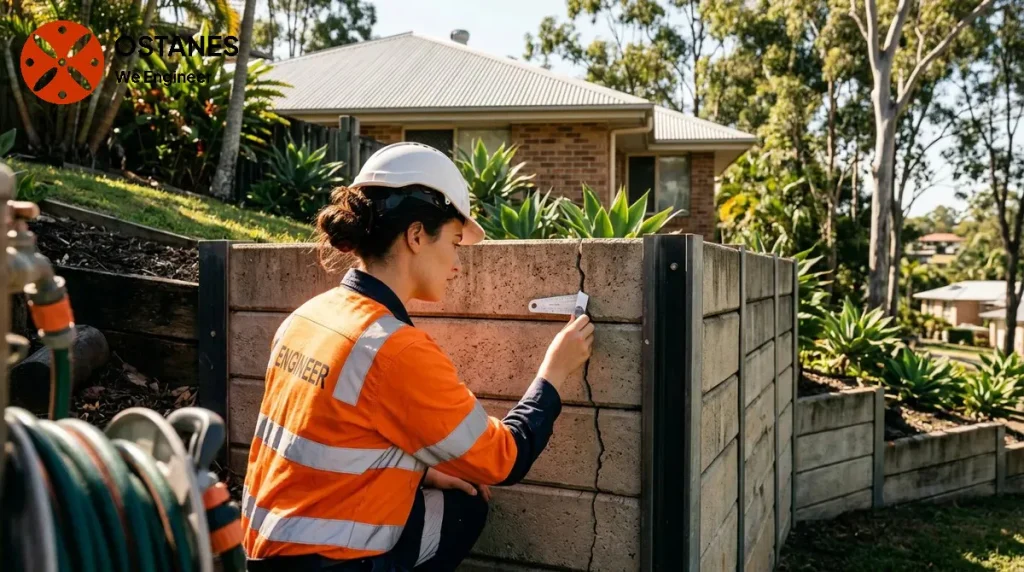
Concrete retaining-wall crack width alone does not establish severity or the repair needed. The wall system, displacement, progression, supports and drainage provide the context for assessment.
What crack patterns and wall changes may indicate
When evaluating concrete retaining wall cracks, a range of observations can provide insight into potential underlying issues. Rather than focusing on a single characteristic, it is more useful to consider combinations of these signs.
Different crack patterns can suggest varying types of movement or stress. For instance, vertical cracks may relate to settlement or differential movement, while horizontal cracks might indicate pressure from retained soil. Diagonal cracks, especially those extending from corners, can be signs of shear stress. The location of these cracks on the wall, whether near the base, top, or at regular intervals, further contributes to this interpretation.
Changes over time are particularly important. A crack that is actively widening or lengthening, or where new cracks are forming, suggests ongoing movement and potential instability. This progression, even if slow, may indicate an evolving issue.
The presence of efflorescence or leaching—white, powdery deposits or mineral stains—can point to water migration through the concrete. While not a direct structural crack, it signals moisture exposure that could contribute to soil saturation behind the wall, increasing hydrostatic pressure and potentially leading to concrete wall movement over time.
Finally, any accompanying wall displacement, such as leaning, bulging, or sections shifting out of alignment, is a critical observation. Even small degrees of movement can be significant when combined with crack patterns and progression. These visual cues, taken together, can help in identifying signs that may require expert evaluation without making a definitive diagnosis.
Why crack width alone cannot establish structural seriousness
Relying solely on crack width to determine the severity of concrete retaining wall cracks is an incomplete approach. A narrow crack might be indicative of minor, superficial shrinkage, but if it is actively widening, accompanied by efflorescence, or part of a larger pattern of wall displacement, its significance changes dramatically. Conversely, a seemingly wide crack in a non-structural location might be stable and pose less immediate concern than a fine, but progressive, crack in a critical section.
The structural seriousness of a crack is influenced by its context: the crack pattern, its position on the wall, whether it is growing, and any signs of moisture or movement in the wall itself. These factors provide a more comprehensive understanding than a single measurement. It is critical to avoid self-diagnosing structural safety or failure from a photograph or isolated observation, as a proper assessment requires professional interpretation of all these combined factors in person. For instance, when evaluating retaining wall crack severity, an RPEQ engineer considers the entire structure and its surrounding environment, not just one feature.
What site conditions can change the interpretation
The conditions surrounding a concrete retaining wall play a significant role in interpreting the significance of any cracks. Soil characteristics, for example, can impact how a wall performs. Expansive clay soils, common in many parts of Queensland, can swell when wet and shrink when dry, exerting considerable pressure on retaining walls. Changes in soil moisture content due to rainfall or drought can lead to differential soil movement, potentially stressing the wall.
Drainage behind and around the wall is another critical factor. Poor drainage can lead to water accumulating against the wall, increasing hydrostatic pressure. This added pressure can contribute to wall movement and cracking. The presence of trees, large shrubs, or nearby construction activities can also influence soil conditions and wall stability.
Retaining-wall assessment considers the actual wall system, retained ground, nearby loads, drainage and support conditions. Residential slab and footing guidance is not a retaining-wall design specification. The engineer should identify the appropriate assessment and design basis for the actual structure.
Queensland context for concrete retaining walls
In Queensland, concrete retaining walls are subject to various considerations, particularly concerning their construction and placement. While specific regulations depend on factors like wall height and proximity to boundaries, the Queensland Development Code provides guidance on boundary clearance and retaining provisions. These guidelines highlight the importance of proper design and construction to ensure stability and avoid impacting adjacent properties. Homeowners encountering cracking or movement in their retaining walls might find their situation falls under these broader provisions, necessitating a review by a qualified professional to ensure compliance and safety.
When professional assessment is appropriate
When observations such as unresolved movement, active displacement, crack progression, or a combination of concerning signs persist in a concrete retaining wall, a professional engineering assessment is appropriate. These indicators suggest that the wall’s integrity may be compromised or that underlying issues are active. Acute-risk scenarios, such as significant leaning, sudden bulging, or any signs of imminent collapse, warrant immediate professional inspection to ensure safety. We approach each situation by thoroughly assessing the observed wall condition on site, considering all contextual factors before providing informed guidance. Such an assessment is crucial for understanding the root cause of the issues and determining suitable actions. A Registered Professional Engineer of Queensland (RPEQ) is qualified to perform such evaluations. For a comprehensive review of your retaining wall’s condition, consider a retaining wall assessment.
Can crack width alone show whether a concrete retaining wall is structurally serious?
No, crack width alone is not a sufficient indicator of structural seriousness. A comprehensive assessment considers the crack’s pattern, location, whether it is growing, and any accompanying signs of wall movement or water issues.
What does efflorescence or leaching on a retaining wall mean?
Efflorescence or leaching, visible as white deposits or mineral stains, indicates that moisture is passing through the concrete. While it does not directly confirm a structural problem, it signals water exposure that can contribute to hydrostatic pressure behind the wall and may indirectly affect its stability over time.
Can a photograph confirm the cause of a retaining wall crack?
Photographs can document the visible signs of cracks but cannot definitively confirm their cause or structural seriousness. A full understanding requires an on-site inspection by a qualified professional who can evaluate the wall in its environmental context.
What wall changes should prompt professional attention?
Signs that should prompt professional attention include any active displacement of the wall (such as leaning or bulging), ongoing crack progression (widening or lengthening), or new cracks appearing. Any combination of these, particularly if they suggest instability, warrants a professional inspection.
Check crack displacement and the wall’s overall behaviour
A concrete crack becomes more informative when its location, displacement, progression and surrounding drainage are recorded. Identify whether the wall is poured concrete, precast panels or concrete sleepers, as their support and connection details differ. A visible crack does not reveal concealed reinforcement, footing dimensions or founding conditions. Ask whether drawings or targeted investigation are needed before deciding on a repair. Cosmetic sealing is not a substitute for assessing a wall that is leaning, moving or losing support.
Related property guidance
For background on the related issue, read concrete sleeper retaining-wall design and condition. Use it alongside the project-specific evidence and service scope described in this guide.
Discuss your project with Ostanes Engineering
For an existing wall showing cracking or movement, begin with structural inspection. If repair or replacement requires a new structural solution, retaining-wall engineering can be scoped separately once the condition and site constraints are understood.
Complete the contact form with your property location, the concern or proposed work, safe photographs and any available drawings, soil report or earlier reports. Contact us through the form for a project-specific cost estimate. The team will respond as soon as possible.
Official references and further reading
For the relevant regulatory or maintenance context, consult Brisbane retaining-wall guidance and QBCC home maintenance. These resources complement the project-specific advice described above.
