
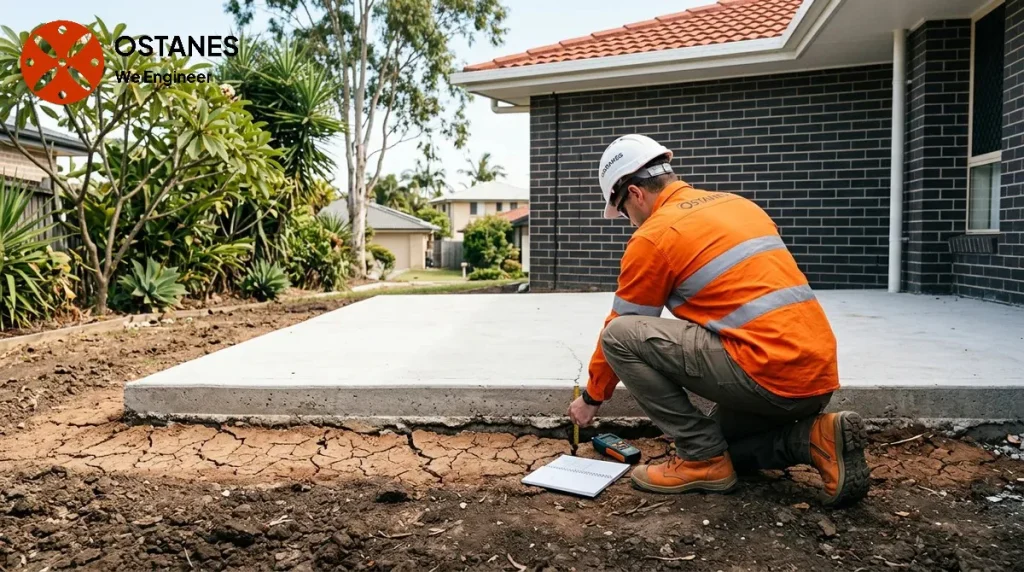
Reactive clay can change volume with moisture conditions, but a site’s classification and the cause of building movement require property-specific evidence. Regional soil information alone is insufficient for foundation design or diagnosis.
What reactive clay means
Reactive clay soils contain minerals that absorb water and expand when wet, and then contract or shrink when they dry out. This characteristic, known as reactivity, means that as seasonal moisture conditions fluctuate, the ground beneath a building can experience upward and downward movement. Uneven ground movement can appear as cracking or other changes in the building above. These changes are a natural response of the soil to environmental factors like rainfall, evaporation, and changes in drainage.
South East Queensland black soils as context
South East Queensland is known for areas containing expansive soils, often colloquially referred to as “black soils” or “black earths.” While these regional descriptions highlight the presence of reactive clays in certain parts of the landscape, it’s important to qualify that general soil mapping or regional context does not definitively establish the specific soil profile or reactivity of an individual property. The actual conditions beneath a particular block of land can vary, even over short distances, due to geological history, cut and fill operations, or localised drainage patterns. Therefore, while regional information about expansive soils provides context, it cannot be used to determine the exact soil type or its reactivity for any given site.
How AS 2870 classification fits the Queensland context
The Australian Standard AS 2870 Residential Slabs and Footings, published by Standards Australia, provides a framework for classifying sites based on expected ground movement due to moisture changes in reactive soils. This AS 2870 site classification system helps engineers design appropriate foundations for residential buildings. The standard uses categories to describe the potential for ground movement:
- Class A: Sites with essentially no ground movement.
- Class S: Slightly reactive sites, where only slight ground movement is expected.
- Class M: Moderately reactive sites, where moderate ground movement is expected.
- Class H: Highly reactive sites, where high ground movement is expected. This class is further subdivided into H1 and H2 site class, indicating different levels of high reactivity.
- Class E: Extremely reactive sites, where extreme ground movement is expected.
- Class P: Problem sites, which include conditions that require specific engineering investigation and design, such as sites on soft soils, uncontrolled fill, or those affected by abnormal moisture conditions.
An AS 2870 site classification is a specific engineering assessment for a particular property, taking into account its unique soil conditions. It is not something that can be assigned generally or inferred from broad regional information.
What building movement can and cannot show
Visible signs such as cracking in walls, uneven floors, or doors and windows sticking may indicate that a building is experiencing movement. While these observations are often associated with reactive clay soils, they cannot definitively prove the cause of the movement, the site class, or the specific foundation problem without a professional assessment. Cracks can form for many reasons, including timber shrinkage, thermal expansion and contraction, or other structural issues unrelated to soil reactivity. The pattern, width, and location of cracks, along with surrounding conditions like tree roots, drainage issues, or recent landscaping changes, may help identify questions for a qualified engineer to investigate. However, relying solely on photographs or descriptions to diagnose the underlying cause of building movement or to assign a site classification is not possible.
When general soil information is not enough
For an existing movement concern, discuss a structural assessment and provide any available soil report. A property-specific site classification or ground investigation may require geotechnical work; it is not automatically supplied by a visual structural inspection.
Can general Queensland soil information tell me my home’s site classification?
No, regional soil information provides general context but cannot provide an official, property-specific AS 2870 site classification. This requires a detailed on-site assessment by a qualified engineer.
What does reactive clay do during seasonal moisture changes?
Reactive clay soils expand when they absorb moisture, typically during wet seasons, and shrink when they dry out. This volumetric change can cause ground movement beneath a building.
Does visible cracking prove reactive clay?
Visible cracking in a building may be an indication of various issues, including reactive clay movement, but it does not definitively prove it. Cracking can have multiple causes, and a professional assessment is needed to determine the actual reason.
What is the difference between understanding AS 2870 and receiving a site classification?
Understanding AS 2870 involves learning about the framework and terminology used for classifying sites based on ground movement potential. Receiving a site classification means a qualified engineer has conducted a property-specific investigation and formally determined the classification for your particular site.
Use the site’s soil evidence rather than a suburb label
Reactive clay behaviour depends on the actual soil profile and moisture conditions. A suburb’s general reputation does not establish a particular site’s classification or the cause of existing cracks. Supply any soil report and note drainage changes, leaks, vegetation and movement history. The engineer may need geotechnical input where founding conditions are uncertain. Moisture-management advice and foundation repair design should respond to the identified circumstances rather than a generic instruction to water the ground or remove trees.
Related property guidance
For background on the related issue, read foundation movement in Queensland. Use it alongside the project-specific evidence and service scope described in this guide.
Discuss your project with Ostanes Engineering
Ostanes Engineering offers a structural crack and movement report to assess the reported symptoms and identify appropriate next steps. If the findings justify new foundations or remedial structural design, foundation structural engineering can be discussed as a separate scope; it is not assumed to be necessary for every crack.
For a project-specific cost estimate, complete the contact form with your property location, the concern or proposed work, safe photographs and any available drawings, soil report or earlier reports. The team will respond as soon as possible.
Official references and further reading
For the relevant regulatory or maintenance context, consult CSIRO foundation maintenance and QBCC subsidence guidance.
