
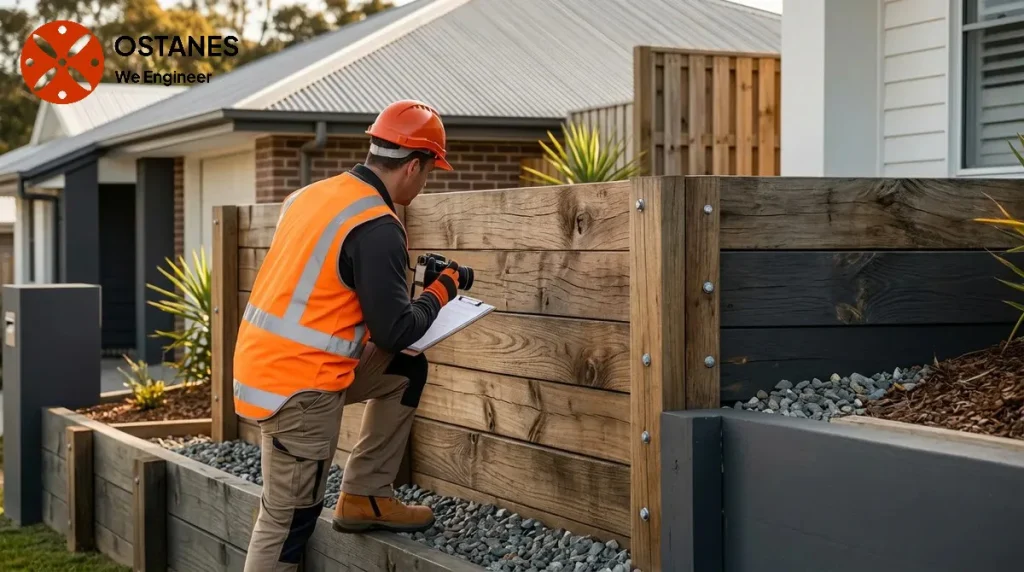
There is no universal service life for a timber retaining wall. Condition, exposure, drainage, treatment and the state of posts and connections are more useful than age alone when deciding on repair or replacement.
What affects timber retaining wall lifespan?
Several interacting factors determine how long a timber retaining wall may last. The initial timber treatment class provides a baseline resistance to decay and insect attack; for instance, H4 and H5 treatment classes are intended for ground contact applications, but their performance depends on a range of site-specific conditions. Effective subsoil drainage is critical, as it prevents water from accumulating behind the wall and saturating the timber. Prolonged soil contact and continuous moisture exposure can accelerate deterioration, even in treated timber.
Why Queensland conditions can change timber wall durability
Queensland’s climate, characterised by high humidity and significant rainfall, can impact timber retaining wall durability. Elevated moisture levels can promote timber decay, especially if drainage is inadequate or if timber remains consistently wet. The frequency and intensity of rainfall events in some areas can also test a wall’s design and construction, particularly its ability to manage water behind the structure. Site exposure to sun and wind can also affect the rate at which timber dries, influencing moisture-related deterioration.
Furthermore, Queensland is home to various termite species that can infest timber structures. Even treated timber may become vulnerable if the treatment breaks down, is compromised, or if termites find untreated sections. These environmental factors mean that a timber retaining wall in Queensland may age differently compared to one in a drier or cooler climate, making site-specific conditions important in evaluating its condition.
Signs a timber retaining wall may be nearing the end of its structural life
Observing specific changes in a timber retaining wall can indicate it may be losing structural integrity. These observations are not a diagnosis of a specific property, but rather indicators that warrant further investigation. Visible decay, such as timber appearing soft, spongy, or brittle to the touch, especially at or below ground level, can be a concern. Signs of insect activity, including boreholes or galleries, may also be present.
Movement is another critical indicator. This can manifest as the wall leaning noticeably, bulging outwards, or showing signs of being out of alignment. Displaced components, such as individual timber sleepers shifting from their original position, or gaps appearing between timber sections, can also suggest instability. Unusual changes behind or around the wall, such as subsidence of the soil, new cracks in adjacent structures, or persistent dampness, may point to issues with the retaining wall’s performance or its drainage. While these observations suggest deterioration, they do not confirm the wall’s structural capacity or remaining service life. Significant movement or acute instability should prompt immediate professional inspection.
Maintenance observations that can reveal deterioration
Regular observation of a timber retaining wall can provide valuable insights into its condition over time. Noticing gradual changes in the wall’s alignment, such as a slight lean or bulge that progresses over months or years, can be more telling than a single observation. Monitoring moisture conditions around the wall, noting areas that remain damp for extended periods, or observing changes in how drainage functions after rainfall, can highlight potential issues with water management. Similarly, keeping an eye on the timber itself for early signs of decay, such as discolouration, cracking, or the presence of fungal growth, allows for tracking deterioration.
A consistent record of these observations contributes to understanding the wall’s history. While these observations do not constitute an assessment of structural integrity or guarantee future performance, they can inform when a more detailed inspection might be appropriate. The history of how the wall has been maintained, or neglected, also helps contextualise its current condition.
Queensland context and when to seek professional advice
Before replacing or substantially altering the wall, confirm the applicable council and building-certification requirements for the actual site. The proposed design should also address nearby structures, retained ground and drainage.
For issues concerning retaining wall stability or deterioration, we approach each concern with a focus on objective assessment and engineering principles. An RPEQ-registered engineer can provide an independent evaluation of the wall’s condition. An RPEQ (Registered Professional Engineer of Queensland) is registered with the Board of Professional Engineers of Queensland (
How long do timber retaining walls last?
There is no universal lifespan for timber retaining walls. Their durability is influenced by the timber treatment, how well drainage is managed, exposure to soil and moisture, termite activity, and site-specific environmental conditions. Regular monitoring for signs of deterioration is more useful than relying on a generic timeframe.
Does H5 timber guarantee a longer-lasting retaining wall?
While H5 treated timber is intended for in-ground applications and offers enhanced resistance to decay and insect attack, its presence alone does not guarantee a specific lifespan or structural condition for a retaining wall. The actual performance depends on other factors like drainage, installation quality, and ongoing site conditions. It is important to remember that H5 treatment provides resistance, not immunity, to deterioration over time.
What are the signs of timber retaining wall failure?
Signs that may indicate a timber retaining wall is experiencing issues include noticeable leaning or bulging, displaced timber sleepers, cracking or softness in the timber, and changes in soil level behind or around the wall. These observations suggest a need for further evaluation, but do not represent a diagnosis of failure for any specific wall.
Can I assess the remaining life of my retaining wall from photographs?
No, photographs alone cannot establish the structural condition or remaining life of a retaining wall. A comprehensive assessment requires an on-site inspection by a qualified professional to evaluate all contributing factors, including those hidden from view or requiring tactile examination.
Do Queensland retaining walls have specific approval or boundary requirements?
Regulatory requirements for retaining walls in Queensland, including those related to approvals or boundary clearances, depend on various factors. These requirements can be found within the Queensland Government’s building laws. For specific guidance, it is recommended to consult official sources or seek advice from a professional familiar with local regulations.
Assess condition instead of assuming a fixed timber lifespan
The age of a timber wall is only one factor. Exposure, treatment, drainage, decay, connections and the condition of posts can influence performance. Photograph visible leaning, rot, displaced members and loss of retained soil without probing an unstable wall. Replacing a single sleeper may not address deteriorated supports or drainage. An assessment should consider the whole wall system and whether repair is practical or replacement design is more appropriate. Avoid promising that any timber wall will last a universal number of years.
Discuss your project with Ostanes Engineering
For an existing wall showing cracking or movement, begin with structural inspection. If repair or replacement requires a new structural solution, retaining-wall engineering can be scoped separately once the condition and site constraints are understood.
Complete the contact form with your property location, the concern or proposed work, safe photographs and any available drawings, soil report or earlier reports. Contact us through the form for a project-specific cost estimate. The team will respond as soon as possible.
Official references and further reading
For the relevant regulatory or maintenance context, consult Brisbane retaining-wall guidance and QBCC home maintenance. These resources complement the project-specific advice described above.
