
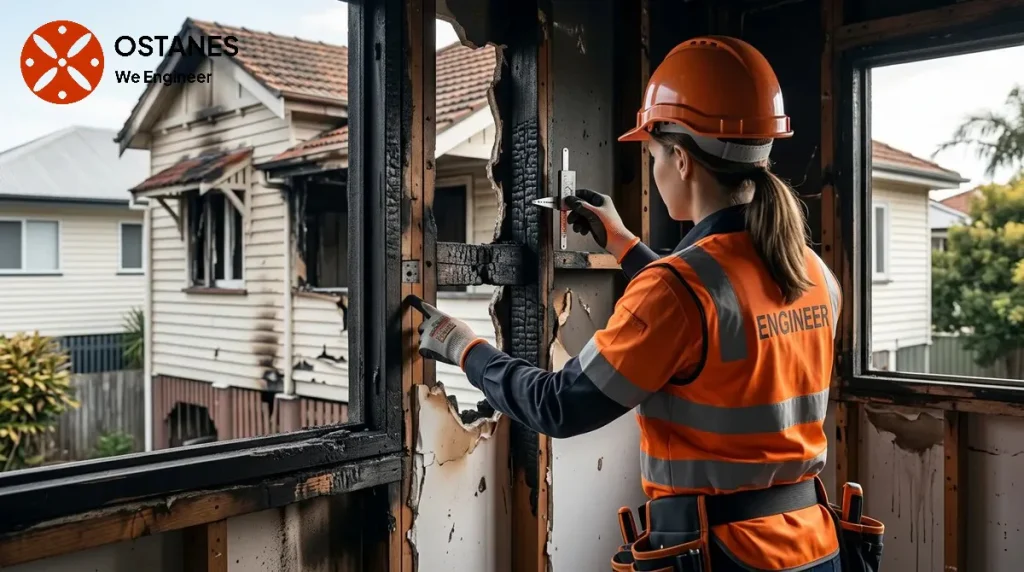
Fire-damage assessment considers the affected structural elements and any concealed effects that can be investigated. Safe access must be addressed first; a visual opinion should not be assumed to resolve every damaged component.
Why fire damage can create structural uncertainty
Surface appearance after a fire can often be misleading, as visible damage to finishes may not fully reveal the condition of underlying structural elements. What appears to be cosmetic damage could mask compromised load-bearing components. Extreme heat can affect materials in ways not immediately apparent, and the methods used to extinguish fires can introduce additional stresses or damage. Therefore, relying solely on visual inspection or photographs can lead to incorrect assumptions about a building’s safety and integrity, necessitating a more thorough examination.
How fire and suppression can affect structural elements
Extreme heat from a fire can qualitatively alter the properties of structural materials. Steel, for instance, may weaken or deform at elevated temperatures. Concrete can spall or crack, potentially exposing reinforcing steel, while timber elements can char and lose cross-sectional area, reducing their load-carrying capacity. These changes may compromise the element’s ability to support loads.
Fire suppression efforts, while essential, can introduce additional challenges. The application of large volumes of water can lead to prolonged wetting of materials, potentially affecting their stability. For example, water absorption can add significant weight to a structure, particularly to saturated insulation or contents, which may exceed its original design capacity. Moreover, the cooling effect of water on superheated materials can induce rapid thermal contractions, potentially leading to further cracking, warping, or delamination. Structural distortion, whether from heat or water, can indicate that the building’s framework has moved out of alignment, potentially impacting its overall stability. These complex interactions mean that a qualitative assessment considering both heat and water exposure is often necessary.
Visible signs that should prompt caution
Several visible signs after a fire can indicate potential structural concerns and should prompt caution. These include cracking in walls, slabs, or beams, which may suggest material distress or movement. Deformation such as bowing, sagging, or twisting of structural elements like roof trusses, floor joists, or columns can signal a loss of integrity. Displacement, where parts of the structure have shifted from their original positions, is another critical indicator.
Charring, particularly deep or widespread, on timber elements means a reduction in their effective cross-section and load-bearing capacity. Similarly, any significant loss of material, whether through burning, spalling, or crumbling, warrants investigation. Damaged connections between structural components are also critical, as these are vital for transferring loads throughout the building. Even widespread smoke effects or evidence of prolonged water exposure can indicate conditions that may have affected hidden structural elements. If any of these signs are observed, it is crucial not to enter, disturb, or attempt to repair the affected areas based on these observations. Instead, these indicators suggest the need for an on-site engineering assessment to evaluate the extent of the damage safely.
When re-entry, repairs or claim discussions require engineering input
Determining when to involve an engineer for post-fire assessment is critical for safety and informed decision-making. Engineering input should be considered before any re-entry into the building, especially if there is visible structural damage, uncertainty about concealed damage, or concerns about overall stability. Even if damage appears localised, heat can travel and affect adjacent or distant structural components.
For repair planning, an engineering assessment helps establish the extent of damage and provides guidance on appropriate remediation. This ensures repairs address the actual structural issues rather than just surface appearance. When engaging in insurance discussions, an engineering report provides an independent, objective evaluation of the structural condition, serving as evidence for the claim. Without this, decisions regarding repair scope or claim eligibility may be based on incomplete information. In any scenario where there is doubt about a building’s structural integrity, particularly if visible distortion is present, seeking professional engineering advice is a prudent step. An immediate professional inspection is advised for any acute-risk scenarios.
What a post-fire structural assessment can and cannot establish
A post-fire structural assessment provides an independent evaluation of the physical condition of a building’s load-bearing elements and stability following a fire event. This type of assessment can identify specific structural damage, evaluate the impact of heat and water on materials, and assess the overall integrity of the structure. It establishes an engineering opinion based on observed evidence and analysis of the building’s condition.
Should I enter a building after a fire if the damage looks localised?
No, visual appearance alone cannot reliably confirm the structural safety of a building after a fire. Heat and water can cause unseen damage to load-bearing elements. If there’s any uncertainty or perceived risk, a professional structural inspection should be conducted before re-entry.
Can fire suppression water cause structural concerns?
Yes, fire suppression water can indeed lead to structural concerns. Large volumes of water can add significant weight to the building, potentially exceeding its design load, and can contribute to material degradation over time if not properly managed.
Does a structural assessment decide whether an insurance claim is accepted?
A structural assessment provides an engineer’s professional opinion on the condition and damage to a building’s structure. This report can be a crucial piece of evidence for an insurance claim, but the final decision on claim acceptance rests with your insurer, not the engineer.
Can photographs confirm whether a fire-damaged building is structurally sound?
Photographs can offer a preliminary visual record, but they cannot definitively confirm a building’s structural soundness after a fire. They do not reveal internal material changes, concealed damage, or the extent of compromise to load-bearing elements, which require an on-site professional assessment.
Agree on access and evidence before a fire-damage visit
Do not enter a fire-affected building until the appropriate professionals have addressed access safety. Provide available incident information, pre-event photographs, drawings and the insurer’s questions. The engineer may need to consider heat exposure, damaged connections, loss of support and concealed effects, with testing or specialist input where a visual inspection is insufficient. Preserve evidence before demolition or repair where safe and practical. A structural opinion addresses the agreed technical questions; it does not decide the insurance policy outcome.
Discuss your project with Ostanes Engineering
Ostanes Engineering’s insurance damage structural report addresses the agreed structural damage questions. A forensic structural investigation may be appropriate where the mechanism or competing explanations require deeper investigation. These services provide technical evidence and do not guarantee claim acceptance.
Complete the contact form with your property location, the concern or proposed work, safe photographs and any available drawings, soil report or earlier reports. Contact us through the form for a project-specific cost estimate. The team will respond as soon as possible.
Official references and further reading
For the relevant regulatory or maintenance context, consult Insurance Council expert-report guidance and Queensland approvals and inspections. These resources complement the project-specific advice described above.
