
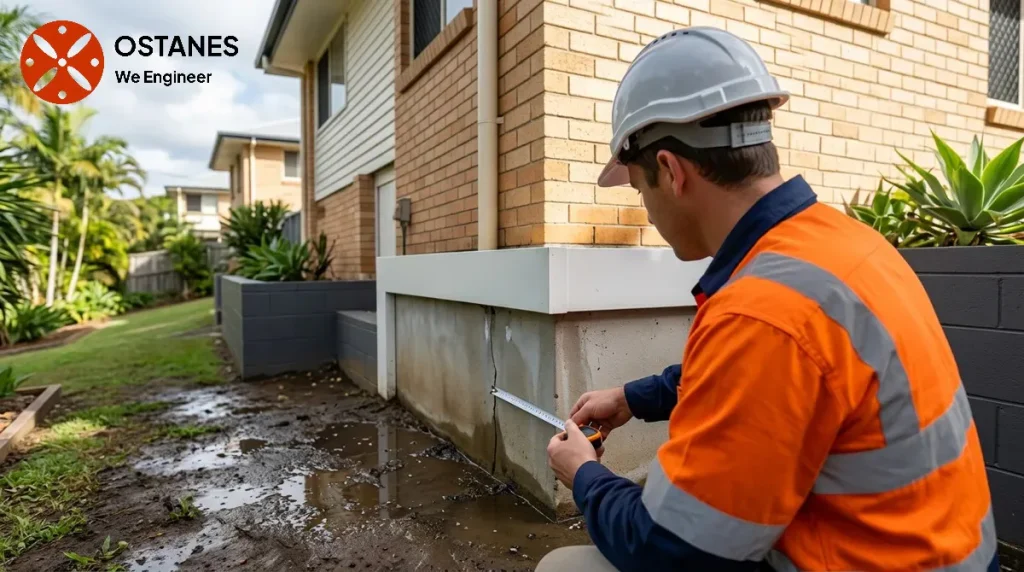
Poor drainage or leaks can change conditions around foundations and contribute to building concerns. Investigate the water source alongside the structural response rather than assuming drainage work alone resolves every crack.
How drainage can affect residential footings
The ground supporting your home’s footings can be sensitive to changes in moisture content. When drainage is poor, conditions such as inadequate surface grading, concentrated downpipe discharge, poor stormwater management, or localised ponding can lead to significant variations in subsoil moisture. These variations can cause expansive soils, common in many parts of Queensland, to swell when wet and shrink when dry. This cyclic movement can stress residential footings and the structures they support. For instance, concentrated discharge from unmanaged downpipes can saturate a localised area, leading to an uneven moisture distribution around the foundation. Such differential moisture changes may contribute to localised ground movement, which can then affect the performance of the footings. While not providing specific design parameters, guidance such as that from the CSIRO footing guidance notes the importance of managing moisture variations to maintain footing performance. Similarly, the AS 2870 footing standard also addresses the influence of soil moisture on foundation stability.
Drainage conditions to observe around a home
Observing how water behaves around your home, particularly after rainfall, can provide insights into potential drainage issues. Pay attention to areas where water collects and remains for extended periods, as this indicates localised ponding. Notice how roof water is discharged; if downpipes release water directly next to the foundation without proper extension or diversion, it could lead to concentrated saturation of the adjacent soil. Examine the ground’s slope around the house; ideally, it should direct drainage away from house foundations. Look for reverse grading, where the ground slopes towards the building, potentially channelling water back to the footings. Additionally, monitor if these conditions change significantly after varying rainfall intensities or during different seasons. These observations are for informational purposes to help you understand your property’s drainage patterns and do not constitute a diagnosis or a recommendation for a specific repair.
Queensland context and professional boundaries
In Queensland, the management of stormwater is an important consideration for property owners. While this article focuses on the structural implications of drainage on foundations, it’s crucial to understand the distinct roles of various professionals. Structural engineering assesses the integrity and stability of your home’s foundation. In contrast, stormwater engineering deals with the design and management of water flow on a property, often involving council regulations. Licensed plumbing services handle the installation and maintenance of pipes and drainage systems. Matters related to the control and management of stormwater, including requirements for drainage and discharge, are addressed in Queensland legislation such as the Building Act 1975 (Qld). It is essential not to confuse the assessment of foundation performance with the specialised services of stormwater engineering or licensed plumbing, as each addresses different aspects of property management. Understanding these boundaries helps ensure you consult the appropriate professional for your specific concern. Concerns about stormwater discharge or plumbing system integrity should be directed to qualified professionals in those fields.
Can poor drainage cause foundation damage?
Poor drainage can be a contributing factor to foundation damage by causing inconsistent moisture levels in the soil around the footings. This can lead to soil expansion and contraction, which may result in foundation movement over time.
How can downpipes affect foundation risk?
Downpipes that discharge roof water directly adjacent to the foundation can concentrate a significant volume of water in one area. This localised saturation can create uneven moisture conditions in the subsoil, potentially increasing the risk of foundation movement.
What does drainage away from a house mean for foundations?
Effective drainage away from a house typically involves grading the ground so that surface water flows away from the foundation. This helps maintain more consistent subsoil moisture levels around footings, reducing the risk of differential soil movement.
When should a Queensland homeowner consult a structural engineer?
A Queensland homeowner should consult a structural engineer if they observe signs of potential foundation distress, such as significant cracking in walls, sticking doors or windows, or uneven floors, especially if these issues appear to be linked to observed drainage problems like persistent ponding or concentrated water flow near the house. A professional assessment can help determine the underlying causes and recommend appropriate actions.
Document drainage changes without excavating beside footings
Record where water ponds, how downpipes discharge and whether leaks or drainage work preceded the symptoms. A plumber or drainage specialist may be needed to investigate and rectify the source. Structural assessment considers the building’s response and whether further ground investigation is warranted. Do not redirect water onto adjoining land or excavate close to supports as a trial solution. Keep photographs and repair records so movement can be compared after the drainage issue is addressed.
Related property guidance
For background on the related issue, read leaking pipes and foundation movement. Use it alongside the project-specific evidence and service scope described in this guide.
Discuss your project with Ostanes Engineering
Ostanes Engineering offers a structural crack and movement report to assess the reported symptoms and identify appropriate next steps. If the findings justify new foundations or remedial structural design, foundation structural engineering can be discussed as a separate scope; it is not assumed to be necessary for every crack.
Complete the contact form with your property location, the concern or proposed work, safe photographs and any available drawings, soil report or earlier reports. Contact us through the form for a project-specific cost estimate. The team will respond as soon as possible.
Official references and further reading
For the relevant regulatory or maintenance context, consult CSIRO foundation maintenance and QBCC subsidence guidance. These resources complement the project-specific advice described above.
