
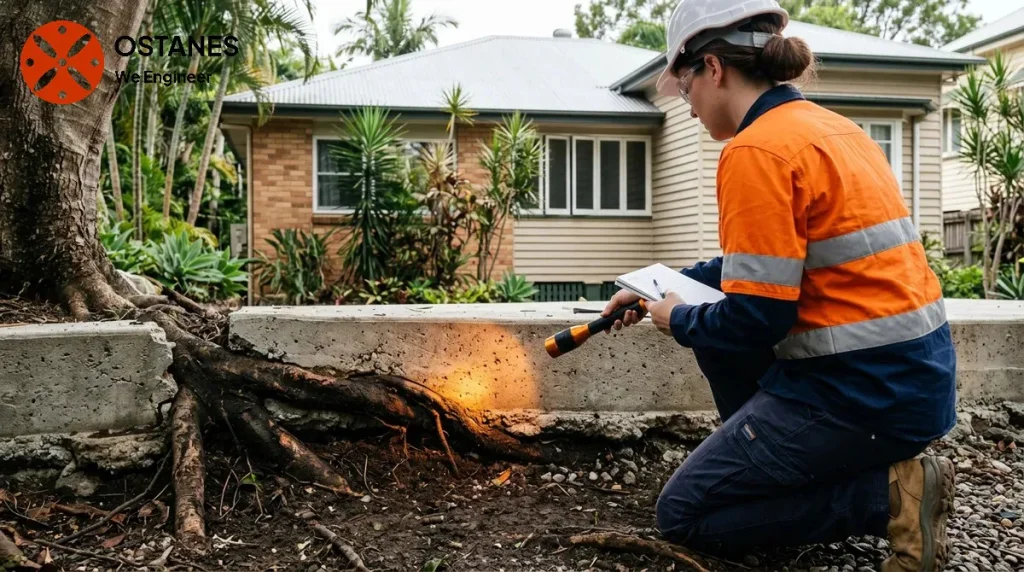
Trees may influence nearby moisture conditions or interact directly with structures, but proximity does not prove causation. Investigate the actual building, drainage, soil and tree circumstances before deciding on intervention.
How soil desiccation may affect foundations
Soil desiccation, the drying out of soil, can occur when vegetation, particularly large trees, absorbs significant amounts of water from the ground. In Queensland’s climate, periods of dry weather combined with water uptake by trees can lead to considerable soil moisture reduction. When reactive clay soils dry out, they can shrink, leading to a loss of support beneath building foundations. This shrinkage can cause differential settlement, where parts of a foundation settle unevenly, potentially leading to stress in the building’s structure. Conversely, during wet periods, these soils can swell as they absorb moisture, also causing movement. These cycles of shrinkage and swelling, known as reactive soil movement, may contribute to foundation issues. The CSIRO’s Foundation Maintenance and Footing Performance guide discusses how varying soil moisture levels can impact footing performance.
How planting proximity affects assessment
The proximity of trees to a house can be a significant factor when assessing potential foundation movement, but it is one element among several. There is no single universal “safe” distance for all trees and all properties, as the impact depends on various site-specific conditions. Factors an engineer may consider include the type and size of the tree, the depth and type of the building’s footings, the nature of the soil (such as its reactivity), local drainage patterns, the prevailing moisture conditions, and the observed patterns of building movement. For instance, a shallow-rooted tree might have a different impact than a deep-rooted species. Similarly, foundations designed to current Australian standards, such as AS 2870 Residential Slabs and Footings, may respond differently to soil moisture changes than older structures. When considering trees too close to a house, the aim is to understand the complete picture of how vegetation, soil, and building interact rather than applying a blanket rule.
Recognising possible root-related foundation movement
Homeowners in Queensland may observe several signs that could indicate foundation movement, some of which might be associated with tree-related soil changes. These include localised cracking in walls, especially near corners of openings like windows and doors, or cracks that appear to radiate from the ground upwards. Soil subsidence, visible as gaps forming between the ground and the foundation, or slumping in garden beds adjacent to the house, can also be an indicator. Changes in floor levels, doors or windows sticking, or misaligned cornices are further observations. While the presence of nearby vegetation and these observations may suggest a connection, they do not confirm that tree roots are the direct cause of foundation damage. Many other factors, such as drainage issues, poor compaction, or inherent soil instability, can lead to similar signs. A detailed, on-site engineering assessment is necessary to differentiate between possible causes and determine if root-associated soil changes are contributing to the observed movement.
Should a tree be removed if cracks appear near a house?
The appearance of cracks near a house does not automatically mean a tree should be removed. Cracks can have various causes. An engineering assessment can help determine if tree-related soil changes are a contributing factor before considering any tree removal.
Can photographs confirm that tree roots damaged the foundation?
Photographs can be useful for documenting the location and extent of cracks or other observations over time. However, they typically cannot confirm that tree roots are the definitive cause of foundation damage. An on-site engineering assessment is usually required to investigate the underlying causes of movement.
What does soil desiccation mean for a Queensland home?
For a Queensland home, soil desiccation refers to the drying out and shrinkage of reactive clay soils, which can lead to a loss of support under building foundations. This process can be influenced by factors like vegetation water uptake during dry periods. It may contribute to foundation movement and cracking.
How close is too close for a tree near footings?
The appropriate distance for a tree from footings is not a fixed measurement. It depends on several factors, including the tree species, its mature size, the type of soil, the design of the foundation, and local moisture conditions. An engineer can assess these site-specific factors.
What should a homeowner record before seeking an assessment?
Before an assessment, it can be helpful to record details such as the location and size of cracks, any observed soil subsidence, the types and locations of nearby trees or large vegetation, and any recent changes in site drainage or moisture conditions around the house. Note when these observations first appeared and if they have changed over time.
Investigate trees alongside drainage and soil conditions
Record the tree’s location, approximate size, observed damage and changes in nearby drainage, but do not assume proximity proves causation. Tree-related moisture changes and direct contact are different mechanisms, and other causes may coexist. Share earlier soil and movement reports with the engineer. Arborist or geotechnical advice may be needed before intervention. Avoid cutting major roots or removing a tree as an unplanned experiment: effects on tree stability, local permissions and building movement should be considered by the appropriate professionals.
Related property guidance
For background on the related issue, read leaking pipes and foundation movement. Use it alongside the project-specific evidence and service scope described in this guide.
Discuss your project with Ostanes Engineering
Ostanes Engineering offers a structural crack and movement report to assess the reported symptoms and identify appropriate next steps. If the findings justify new foundations or remedial structural design, foundation structural engineering can be discussed as a separate scope; it is not assumed to be necessary for every crack.
Complete the contact form with your property location, the concern or proposed work, safe photographs and any available drawings, soil report or earlier reports. Contact us through the form for a project-specific cost estimate. The team will respond as soon as possible.
Official references and further reading
For the relevant regulatory or maintenance context, consult CSIRO foundation maintenance and QBCC subsidence guidance. These resources complement the project-specific advice described above.
