
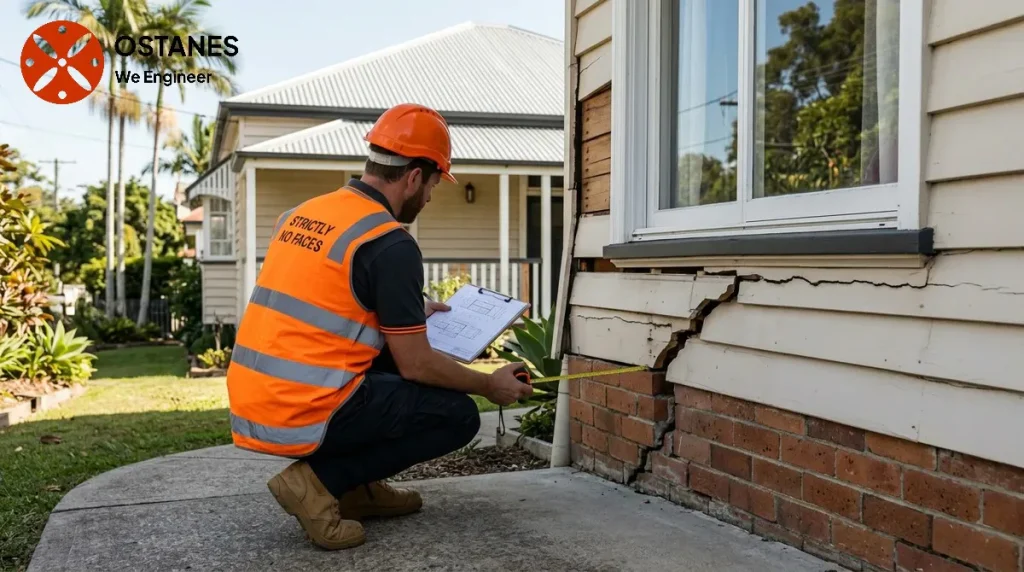
A structural report for an insurance claim should answer clearly defined technical questions about the damage and available evidence. It supports the claim discussion but does not determine policy cover or guarantee payment.
When a Structural Engineer’s Report May Be Relevant
An independent structural report can help document visible damage to a property, distinguishing objective observations from assumptions about its origin or severity. If you observe signs such as new or widening cracks in walls, significant settlement of foundations, or unexpected movement in structural elements, these may indicate a need for a technical assessment. An engineer can evaluate the nature of this damage, its extent, and whether it appears consistent with reported events.
However, visible damage alone does not automatically confirm its cause or whether it falls within the scope of an insurance policy. A structural engineer’s on-site assessment can provide a more thorough understanding than relying solely on photographs or descriptions. For situations involving acute risks, such as sudden structural collapse, significant tilting of walls, or widespread cracking that suggests imminent failure, immediate professional inspection is crucial. These situations require prompt attention to ensure safety and prevent further damage.
What an Independent Report Can and Cannot Establish
An independent structural engineer’s report primarily establishes objective observations about the condition of a property’s structure. This can include documenting visible defects, measuring crack widths, and noting patterns of distress. The report may also assess the probable causes of damage based on engineering principles and site evidence. This differs from an insurer’s claim decision, which is based on policy terms, coverage, and assessment of all evidence. A structural engineer’s report provides technical findings and, where applicable, high-level technical remediation recommendations, but it does not determine policy coverage, establish liability, or guarantee a specific insurance outcome.
Engineer, Builder and Insurance Loss Adjuster: Different Roles
When property damage occurs, several professionals may be involved, each with a distinct role. An independent structural engineer provides a technical assessment of the damage, focusing on its nature, extent, and probable causes from an engineering perspective. Their role is to offer an expert opinion on the structural integrity and stability of the affected property.
A builder, in contrast, focuses on the practical aspects of construction and repair. Their expertise lies in estimating repair costs, planning construction work, and executing the physical repairs to restore the property.
An insurance loss adjuster assesses the claim on behalf of the insurer. Their role, as described by the Insurance Council of Australia, is to investigate the circumstances of the claim, evaluate the damage against the terms of the insurance policy, and recommend whether the claim should be paid and for what amount. While an engineering report can serve as structural damage evidence for the loss adjuster’s review, the loss adjuster ultimately applies policy terms to determine the claim’s outcome. Although these roles contribute to the process, the insurer’s decision is separate from the technical findings of an engineering report or a builder’s repair assessment. Specific responsibilities can vary.
What to Clarify Before Relying on Technical Evidence
Before proceeding with an independent structural assessment, it is important to clarify your insurer’s specific evidence requirements. Policies vary, and understanding what technical information your insurer requires can help guide the assessment process. Consider what specific technical questions an engineer may need to address, such as the cause of a particular crack pattern or the stability of a damaged foundation. An engineer’s assessment can provide valuable insights into the technical aspects of property damage, but it is always advisable to understand how this evidence will integrate with your insurance claim.
Can a structural engineer’s report guarantee an insurance claim outcome?
No. A structural engineer’s report provides objective technical evidence regarding property damage and its probable causes. However, it cannot guarantee approval of an insurance claim, coverage under a policy, or any specific outcome from your insurer.
What can a structural engineer assess after property damage?
A structural engineer can assess visible damage such as cracks, deformations, or settlement patterns, and offer an opinion on their nature and probable causes based on engineering principles. They do not prescribe specific repair methods or offer DIY advice.
Is a builder’s opinion the same as an independent structural report?
No, a builder’s opinion typically focuses on construction practices, repair methods, and cost estimates. An independent structural report, prepared by a qualified engineer, provides a technical assessment of the structural integrity and safety implications of the damage, from an engineering perspective.
Does an insurance loss adjuster replace a structural engineer?
No. An insurance loss adjuster’s role is to assess an insurance claim against policy terms. A structural engineer’s role is to provide a technical evaluation of property damage. These roles address different aspects of an insurance claim.
Ask for a report that answers the insurer’s actual questions
Provide the policy correspondence and any existing assessor reports, but avoid asking the engineer to guarantee acceptance of a claim. A useful brief identifies the affected elements, relevant event, competing explanations and evidence available. The report should separate observations, assumptions, analysis and conclusions, and explain any need for testing or further access. Keep a record of how evidence was obtained. If the dispute concerns policy interpretation rather than structural cause, use the insurer’s dispute process and obtain the appropriate non-engineering advice.
Discuss your project with Ostanes Engineering
Ostanes Engineering’s insurance damage structural report addresses the agreed structural damage questions. A forensic structural investigation may be appropriate where the mechanism or competing explanations require deeper investigation. These services provide technical evidence and do not guarantee claim acceptance.
For a project-specific cost estimate, complete the contact form with your property location, the concern or proposed work, safe photographs and any available drawings, soil report or earlier reports. The team will respond as soon as possible.
Official references and further reading
For the relevant regulatory or maintenance context, consult Insurance Council expert-report guidance and Queensland approvals and inspections.
