
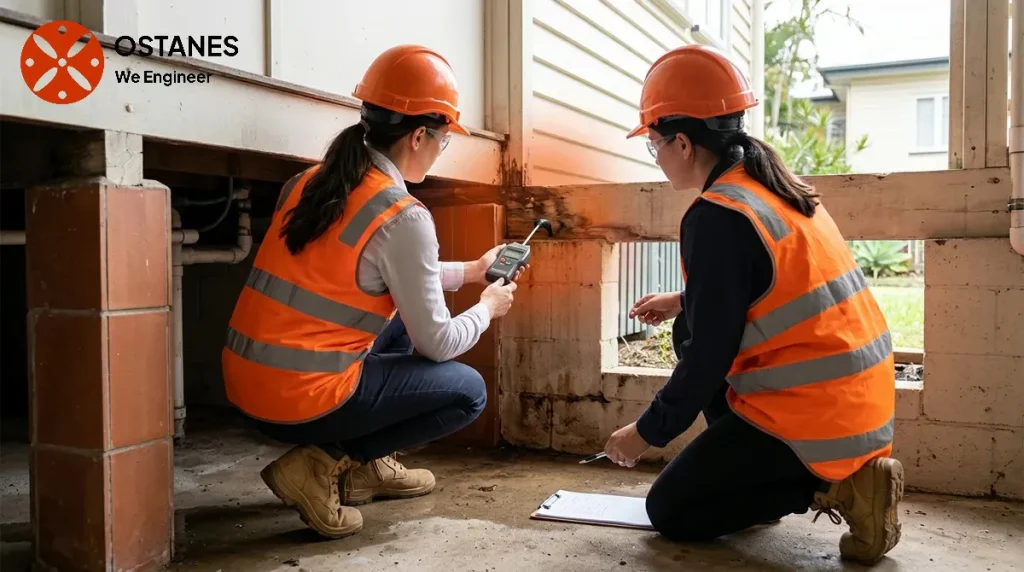
Water damage becomes a structural question when affected members, connections, supports or ground conditions may have changed. Stopping the water source and assessing the structural consequences are complementary tasks.
Cosmetic Moisture or Possible Structural Degradation
Distinguishing between cosmetic moisture issues and potential structural degradation requires careful consideration. Surface staining, damp finishes, or minor plaster bubbling might appear cosmetic, but their presence near structural elements like columns, beams, or load-bearing walls may indicate deeper issues. The significance of water ingress depends on several factors: its location within the building, the duration of exposure, the extent of the affected area, the specific material involved, any observed movement, and the overall site context. For instance, a persistent damp patch on a plasterboard wall might be cosmetic, but if that same dampness is present on a timber wall frame or a concrete slab, the implications could be different. Without a professional assessment that considers all these elements, it is challenging to determine if moisture is merely cosmetic or if it points to a condition affecting structural performance.
How Water Exposure Affects Different Structural Materials
Water exposure impacts various building materials in distinct ways, each presenting its own set of potential structural concerns.
For timber framing, prolonged moisture can lead to decay, rot, and fungal growth. This deterioration can reduce the timber’s section and strength, compromising its ability to support loads. Visible signs may include softening, discolouration, or distortion of timber members.
Structural steel, when exposed to moisture and oxygen, is susceptible to corrosion (rust). Rust expands, which can exert pressure on surrounding materials and reduce the effective cross-section of steel elements, thereby weakening their load-carrying capacity. Severe corrosion can also compromise connections between steel members.
Concrete and embedded reinforcement can also be affected by water. While concrete itself is generally durable, excessive moisture can lead to efflorescence (salt deposits), spalling (surface flaking), or cracking. More critically, if water reaches the steel reinforcement within the concrete, it can cause the rebar to corrode and expand. This expansion creates internal stresses that can crack and delaminate the concrete cover, further exposing the reinforcement and accelerating deterioration.
Foundation subgrade soils are particularly vulnerable to water. Saturation can reduce the soil’s bearing capacity, leading to settlement or differential settlement of the structure. Erosion can wash away fine soil particles, creating voids beneath footings. Prolonged dampness can soften clay soils, causing them to lose strength. These changes in the supporting soil can manifest as cracking in walls, uneven floors, or binding doors and windows.
It is important to remember that these are potential mechanisms of damage; diagnosing the extent and implications of water exposure requires specific assessment.
Structural Water Damage Signs
Observable signs that may indicate structural water damage include distortion or warping of building elements, particularly timber floors, walls, or roof structures. Movement, such as bowing walls, sagging ceilings, or noticeable shifts in the building’s alignment, can also be a significant indicator. Evidence of corrosion on steel components, including discoloured rust streaks or flaking metal, points to moisture ingress. Material deterioration, such as crumbling concrete, excessive timber rot, or the breakdown of masonry mortar, signals a loss of integrity.
Changes around structural supports, such as cracks in the walls radiating from column bases or unevenness around footing lines, may indicate foundation issues. Unusual settlement indicators, like new or widening cracks in brickwork or concrete slabs, or floors that are noticeably out of level, suggest movement in the supporting ground. Recurring moisture, dampness, or visible water stains at or near structural elements, especially in basements, crawl spaces, or along lower walls, warrant attention.
Any of these observations should be viewed as reasons to seek professional assessment, rather than as a definitive self-diagnosis of cause or severity. If you observe acute conditions such as sudden significant structural movement, severe cracking, or visible instability, immediate professional inspection is advised.
Building Context and the Limits of Visual Assessment
The structural performance of any building, and the specific requirements it must meet, are governed by its unique building context. This includes factors such as its age, construction type, local environmental conditions, and the intended use of the structure. Australian building requirements, such as those outlined in the National Construction Code published by the ABCB (ncc.abcb.gov.au), define standards for structural adequacy and moisture management. However, purely visual observations cannot, by themselves, establish whether a building meets these requirements or if it is structurally sound. While visible signs like cracks or dampness can suggest a problem, their cause, depth, and impact on structural integrity require a more in-depth, informed evaluation. A qualified professional considers these visual cues within the broader framework of engineering principles and applicable standards.
Separating Water-Event Evidence from Structural Conclusions
It is important to differentiate between records confirming a water event and evidence that structural damage has occurred. Documentation such as rainfall data from the Bureau of Meteorology (bom.gov.au) or insurance records from the Insurance Council of Australia (insurancecouncil.com.au) may establish that a flood, storm, or plumbing failure took place. However, these records alone do not provide a definitive conclusion about whether structural elements or supporting soils have deteriorated. Photographs of a waterlogged room, for example, show that an event occurred, but they do not automatically quantify the impact on structural components or the long-term integrity of the building. An engineering assessment specifically determines the extent of any structural compromise, which is a different evaluation from merely confirming the presence of water.
Can water damage cause structural problems in a building?
Yes, prolonged or significant water exposure can lead to structural problems by affecting materials like timber, steel, and concrete, or by compromising foundation soils. The risk and severity depend on the specific material, the duration and extent of exposure, and the overall building and site context. Uncertain or potentially significant conditions should be assessed by a qualified engineer.
What are structural water damage signs?
Structural water damage signs can include distortion or warping of building elements, new or widening cracks in walls or slabs, visible corrosion on steel, softened or decaying timber, or uneven settlement of floors. These are indicators that warrant professional assessment to determine their cause and implications for structural integrity.
Can photographs confirm structural water damage?
Photographs can document the presence of water or visible damage, but they have limitations. They cannot confirm the depth, extent, or structural implications of damage, nor can they definitively determine the cause or severity of issues. An on-site inspection by a qualified professional is typically required for a comprehensive assessment.
Does water damage affect foundation soils?
Yes, water can significantly affect foundation soils. Saturation can reduce a soil’s bearing capacity, erosion can wash away supporting material, and changes in moisture content can lead to softening or swelling of clay soils. These effects can result in movement or settlement of the building’s foundation, potentially causing structural issues.
Should visible moisture near a structural element be assessed?
Visible moisture near a structural element, such as a timber post, steel beam, or load-bearing wall, should prompt assessment. While not all moisture indicates immediate structural failure, its presence can initiate or accelerate deterioration processes in these critical components. An engineer can evaluate the situation to determine if structural integrity is compromised.
Find the water source as well as the affected structure
Record whether water came from a plumbing leak, roof leak, overland flow or inundation, and when the affected materials became wet. A plumber, roofer or other trade may be needed to stop the source. Structural assessment considers affected members, connections, supports and ground conditions within its scope. Dry-looking surfaces do not necessarily show the condition of concealed materials. Do not cover damage before it is documented if a claim or repair investigation is likely, and coordinate drying and reinstatement with the relevant professionals.
Discuss your project with Ostanes Engineering
Ostanes Engineering’s insurance damage structural report addresses the agreed structural damage questions. A forensic structural investigation may be appropriate where the mechanism or competing explanations require deeper investigation. These services provide technical evidence and do not guarantee claim acceptance.
Complete the contact form with your property location, the concern or proposed work, safe photographs and any available drawings, soil report or earlier reports. Contact us through the form for a project-specific cost estimate. The team will respond as soon as possible.
Official references and further reading
For the relevant regulatory or maintenance context, consult Insurance Council expert-report guidance and Queensland approvals and inspections. These resources complement the project-specific advice described above.
