
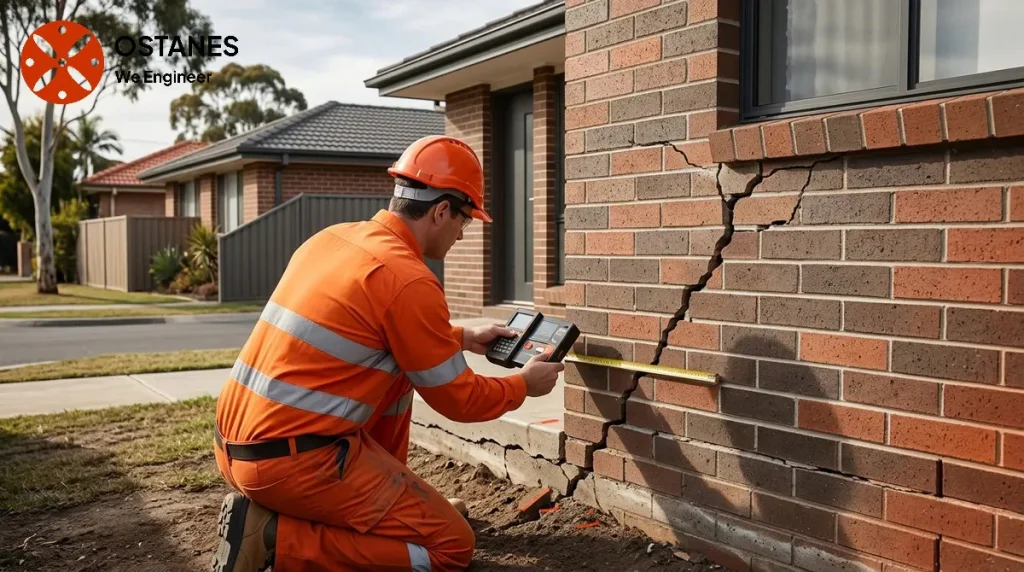
Collingwood Park has documented historical mine-subsidence events, but an individual property’s present condition needs its own evidence. Check the location, relevant records and movement history before attributing damage to mining.
What Warning Signs Deserve Closer Assessment?
When assessing your home, certain patterns and changes may indicate ground movement that deserves closer investigation. These are observations, not definitive diagnoses, but they point to a need for professional assessment rather than immediate repair or remediation.
- Crack Location and Pattern: Cracks appearing in specific areas, such as corners of window or door openings, or running diagonally across walls, may suggest differential movement. Cracks that appear to connect across different building elements can also be significant.
- Crack Direction and Width: Vertical, horizontal, or stepped cracks each offer different clues about the forces acting on a structure. Cracks that are notably wide or appear to be concentrated in particular areas may warrant further attention.
- Associated Separation: Look for gaps between walls and ceilings, or between skirting boards and floors. Separation of elements like brickwork, architraves, or cornices can accompany cracking and suggest broader structural shifts.
- Changes in Level or Alignment: Doors or windows that suddenly stick, floors that feel uneven, or visible sloping of floor slabs can be indicators of ground movement impacting the building’s foundation.
- Progression Over Time: Monitoring whether cracks are increasing in length, width, or number is crucial. New cracks appearing or existing cracks widening over weeks or months suggest ongoing movement.
These observations, particularly when occurring in combination or showing signs of progression, may indicate a need for an on-site RPEQ assessment. Many factors can cause house cracking. An engineer needs to assess the property before attributing it to mining.
Why Collingwood Park Context Matters?
Collingwood Park’s history, particularly its association with historical mining activities, means that ground conditions can be a particular concern for property owners. However, it is important to understand that not all Collingwood Park house cracking is attributable to mine subsidence. Geological context can play a role in understanding potential ground movement. For general information on Australia’s geology, Geoscience Australia provides resources that describe broad geological features. Local ground conditions, including soil types and moisture variations, can also significantly influence a building’s foundations. An understanding of the local environment helps in framing any investigation, allowing for an informed assessment of whether observed building movement relates to subsidence or other factors. Causal links between historical mining, geological conditions, and current building movement cannot be assumed without specific site investigation.
Why Cracking Does Not Prove Mine Subsidence
Visible cracking in a home is a common concern for homeowners, but it is important to differentiate between a symptom and its underlying cause. House cracking does not, on its own, prove mine subsidence. Building movement can result from a variety of factors, including reactive soils that expand and contract with moisture changes, inadequate foundation design for site conditions, drainage issues, tree root activity, or even normal settlement over time.
The design of residential slabs and footings in Australia, such as those covered by AS 2870, considers various site classifications and expected ground movements to minimise cracking. However, even well-constructed homes can develop cracks due to unforeseen environmental changes or other factors. An engineer evaluates all potential causes during an assessment, rather than attributing every crack to mine subsidence without detailed investigation.
Property Records and Local Mining History
Before seeking an engineering assessment, gathering relevant property records and historical information can provide valuable context. This information helps engineers in their investigation but does not confirm or deny mine subsidence on its own.
Publicly available resources may include:
- Abandoned Mine Records: The Queensland Department of Resources provides information relating to abandoned mines and historical mining land. Checking these resources may indicate if a property is located in an area with a history of mining activity.
- Geological Context: Resources from Geoscience Australia can offer general geological information for the area, helping to understand broader subsurface conditions.
- Council Building Records: Ipswich City Council’s building and planning services may hold records pertaining to a property’s construction or previous approvals, which can inform an engineer’s assessment.
While these records can highlight the potential for historical mining influence or specific geological conditions, they cannot confirm the direct impact on an individual property or establish the cause of observed building movement. They serve as valuable background information for a professional structural assessment.
What Progression Can and Cannot Tell You?
Observing the progression of cracks or other signs of movement over time is a critical step in understanding the potential severity of an issue. If cracks are visibly increasing in length or width, if new cracks are appearing, or if previously stable elements begin to shift, it suggests ongoing movement. Documenting this progression through dated photographs, measurements, or marking the ends of cracks can provide valuable evidence for an engineer.
While progression indicates that movement is active, it does not confirm mine subsidence as the cause, nor does it provide a specific timeframe or threshold for intervention. Various factors can cause ongoing movement. Rapid or significant progression, however, should prompt immediate professional inspection, as it may suggest an urgent issue. Documenting changes without attempting to self-diagnose provides objective information that an RPEQ engineer can interpret.
Recommended Next Steps
If you are concerned about movement in your Collingwood Park home:
- Record cracks, uneven floors and structural changes. Date photographs and note their locations.
- Gather available mining records, geological information and council building documents.
- Avoid assuming the cause. Several factors can cause house cracking.
- Arrange an on-site assessment by an RPEQ engineer to investigate the cause.
Can house cracking in Collingwood Park confirm mine subsidence?
No, cracking in a house alone cannot confirm mine subsidence. While cracks can be a symptom of ground movement, many other factors, such as reactive soils, drainage issues, or normal building settlement, can also cause them. A professional structural engineering assessment is required to determine the actual cause.
Which mine movement warning signs deserve closer attention?
Signs that warrant closer attention include persistent or widening cracks, particularly those in diagonal patterns around openings, or cracks accompanied by separating elements like cornices or skirting boards. Changes in floor levels, sticking doors or windows, and any visible progression of these signs over time are also important indicators that suggest the need for professional evaluation.
Can property records show whether a home is affected?
Property records, including historical mining maps, geological surveys, and council building documents, can provide valuable contextual information for an engineer. However, these records do not confirm or deny that a specific home is affected by mine subsidence. They serve as background data for a detailed, on-site assessment.
Does progression prove subsidence?
Progression, meaning cracks or other signs of movement that worsen over time, indicates ongoing ground or structural movement. While progression increases the urgency for an investigation, it does not definitively prove mine subsidence. An RPEQ engineer will assess the nature and rate of progression to help determine the underlying cause and severity.
Avoid extending Collingwood Park findings to every address
Queensland’s Collingwood Park remediation information documents historical events and affected mining areas. Check the actual property against the available information and obtain relevant records rather than making a suburb-wide diagnosis. A building inspection and a ground-risk investigation answer different questions. Share past movement reports, repairs and any authority correspondence with the engineer. Historical remediation or monitoring does not by itself confirm the present condition of an individual house, and any assistance scheme must be checked against its stated eligibility conditions.
The Queensland Collingwood Park information page records subsidence events in December 1988 and April 2008. Historical event information helps establish context; any current property assessment or assistance eligibility must be checked separately.
Discuss your project with Ostanes Engineering
For help with the structural questions in this guide, discuss structural crack and movement report with Ostanes Engineering. forensic structural investigation may also be relevant where the assessment or proposal identifies that need. Agree on the scope, evidence and deliverables before commissioning additional work.
For a project-specific cost estimate, complete the contact form with your property location, the concern or proposed work, safe photographs and any available drawings, soil report or earlier reports. The team will respond as soon as possible.
Official references and further reading
For the relevant regulatory or maintenance context, consult Queensland Collingwood Park information and QBCC subsidence guidance.
