
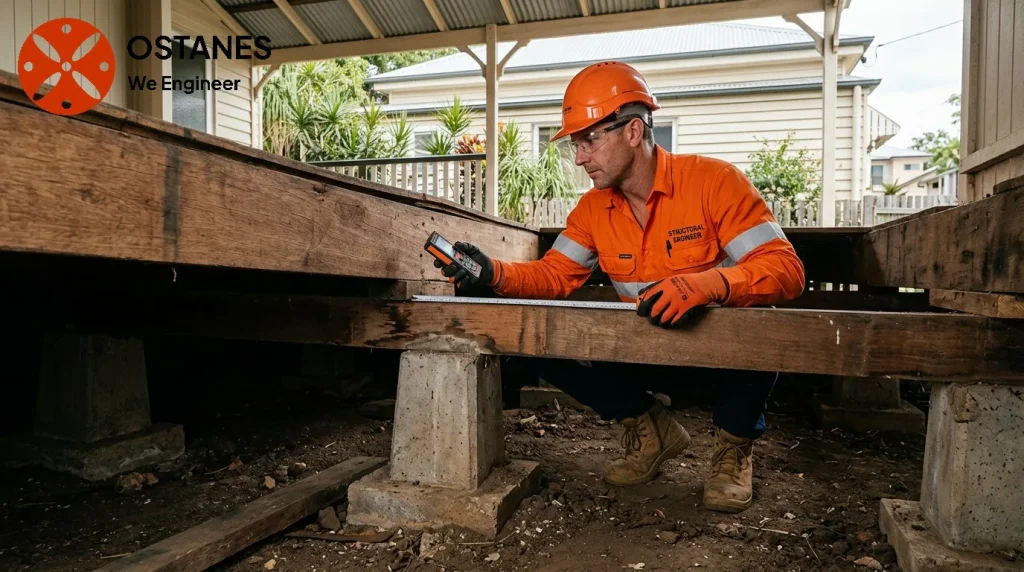
Sagging floors can involve damaged framing, deteriorated supports or movement of the ground. A local dip and a gradual slope may need different investigations; neither should be diagnosed from a photograph alone.
What sagging or uneven floors can mean
Uneven floors in a house can manifest in several ways, each potentially indicating different underlying issues. A floor might feel soft or bouncy underfoot without any obvious visual sag, or it could show a clear dip or slope. These conditions often relate to various factors, including the supporting framing, the subfloor’s condition, or external environmental influences.
Possible causes include deteriorated timber or steel framing, damaged supports, and moisture accumulation in a poorly ventilated subfloor. Drainage changes or reactive soil movement can affect the foundations. Removing load-bearing walls or adding excessive loads can also cause floor deflection. These are possibilities to investigate; diagnosis requires an on-site assessment.
How to distinguish floor movement from settlement
Distinguishing between types of floor movement requires careful observation. There are generally three categories: noticeable bounce or movement, visible floor deflection, and overall building settlement.
Noticeable bounce or movement typically involves a floor feeling springy or vibrating when walked upon, without a clear visual sag. This can sometimes indicate a bouncy floor structural problem, potentially related to under-specified floor joists, inadequate bracing, or issues with subfloor connections. The movement might be localised to specific areas or more widespread.
Visible floor deflection occurs when the floor surface clearly dips or sags, often noticeable by the eye or when placing a straight edge across the floor. This can be caused by long-term creep in timber elements, overloading, or localised structural issues affecting specific floor sections. Observing whether the deflection is isolated to one room or spans multiple areas can provide clues.
Overall building settlement is a more pervasive issue where the entire building, or a significant portion of it, sinks or shifts. This usually manifests not only in uneven floors but also in other connected signs throughout the building, such as cracks in walls, misaligned doors and windows, or roofline irregularities. The pattern of cracks, their width, and whether they are active (widening over time) are important observations.
While these observations can help narrow the possibilities, they do not confirm a cause. Symptoms often overlap, and what appears to be visible floor deflection might be part of a broader settlement issue. An on-site engineering assessment is necessary for accurate determination.
Queensland context: soil, climate and building movement
In Queensland, local soil types, climate patterns, and moisture conditions play a significant role in building movement, which can manifest as uneven floors or settlement. The region experiences diverse soil conditions, from reactive clays that swell and shrink with moisture changes to sandy soils that can consolidate under load. Prolonged dry spells followed by heavy rainfall, common in Queensland, can exacerbate these soil movements.
The performance of residential slabs and footings is generally addressed by standards such as the AS 2870 residential standard. Building design and construction also consider these environmental factors, often guided by the National Construction Code. While these documents provide frameworks for construction, specific site conditions and environmental changes can still lead to movement over time. Understanding this context helps to appreciate why an engineer assesses not just the visible symptoms but also the environmental factors that may contribute to building behaviour in Queensland.
Observations to record before seeking advice
Before seeking professional advice, gathering specific observations about your uneven floors can be helpful. Note where the floor feels or appears uneven—is it concentrated in one spot, a particular room, or across multiple areas? Is the movement isolated, or does it seem to be widespread throughout the house? Look for associated changes in other parts of the building, such as new or widening cracks in walls, sticking doors or windows, or unusual gaps. Pay attention to any visible signs of moisture, dampness, or drainage issues around the foundation or subfloor areas, especially after rain. Try to determine if the condition is static or appears to be worsening over time. Documenting these observations, perhaps with dated photos, provides valuable context for an assessment.
When observations need professional attention
If you observe acute, worsening, or potentially unsafe movement in your floors or other parts of your property, it is important to seek immediate professional inspection rather than attempting self-assessment. These situations may indicate a more serious underlying issue that requires prompt attention.
Are sagging floors always a structural problem?
No, sagging floors are not always indicative of a structural problem, though they can be. Sagging can result from various factors, including minor timber deflection, inadequate support, or broader settlement. The symptom alone cannot confirm a diagnosis; an assessment is required to determine the cause and severity.
What is the difference between a bouncy floor and a sagging floor?
A bouncy floor typically refers to movement or vibration felt underfoot without a significant visible dip. A sagging floor, conversely, involves a noticeable visual deflection or slope in the floor surface. Both indicate a need for professional context and cannot be definitively diagnosed remotely.
Can uneven floors be caused by building settlement?
Yes, uneven floors can be a symptom of broader building settlement, where the entire structure or a significant part of it has shifted. However, unevenness can also stem from localised issues not related to overall settlement. An assessment of the pattern of movement and associated building symptoms helps confirm the cause.
Should I inspect or repair a sagging floor myself?
It is not advisable to attempt DIY diagnosis or repairs for a sagging floor, as this can involve structural elements. Avoid exposing structural components or undertaking fixes without professional advice. If you suspect acute or potentially unsafe conditions, seek a professional inspection immediately.
Distinguish floor framing movement from ground movement
For a raised Queensland house, the investigation may need to consider bearers, joists, posts, connections and moisture or pest damage as well as the foundations. For a slab-on-ground house, the evidence and access are different. Describe whether the floor slopes gradually, dips locally or moves under normal use. Avoid adding supports or jacking a floor as a DIY diagnostic test. A repair decision should follow assessment of the load path and cause, with temporary support addressed by the responsible professionals where needed.
Discuss your project with Ostanes Engineering
For help with the structural questions in this guide, discuss structural crack and movement report with Ostanes Engineering. structural inspection may also be relevant where the assessment or proposal identifies that need. Agree on the scope, evidence and deliverables before commissioning additional work.
For a project-specific cost estimate, complete the contact form with your property location, the concern or proposed work, safe photographs and any available drawings, soil report or earlier reports. The team will respond as soon as possible.
Official references and further reading
For the relevant regulatory or maintenance context, consult QBCC home maintenance and CSIRO foundation maintenance.
